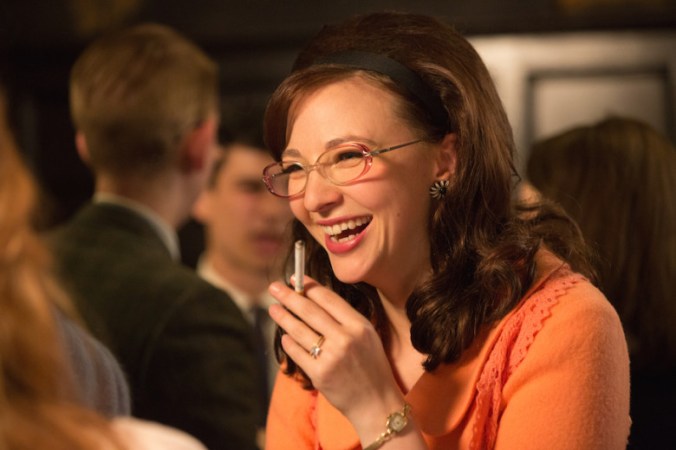
Those Last Four Words

Gilmore Girls was never a great show. It was a good show, and I watched every episode, but it never cracked my Top Five, maybe not even the Top Ten. I was mainly excited about the reboot because it gave the creator a chance to end the story on her own terms.

The mythology around the show states that Amy Sherman-Palladino had always known the final four words that would be spoken in the series. She’d written the arc with that ending in mind. But contract negotiations fell through, so the seventh and final season went in a different direction. We saw Rory hopping on the campaign bus to cover the Obama candidacy, which seemed like a great ending in 2007 because HOPE.

barack_obama_hope_poster

Fast forward nine years and we find Rory floundering. Vogue had a surprisingly wry take on this, and a couple of other sites have pointed out how the prodigal daughter is just too damn spoiled and pumped full of praise to really make anything of herself. I’ve always wondered why Rory’s hero was Christiane Amanpour when Rory rarely showed any interest in current events, politics, or global affairs. I secretly agreed with Headmaster Charleston when he grilled Rory about her ambitions:

Headmaster : Why do you wish to be Christiane Amanpour?

Rory : I don’t wish to be her, exactly. I just want to do what she does.

Headmaster : Which is?

Rory : Travel, see the world up close, report on what’s really going on, and to be part of something big.

Headmaster : And to be a part of something big you have to be on TV? Why not lead the police on a high speed chase, it’s a quicker way to achieve this goal.

We used to get this sort of applicant when I worked at the newspaper; the blank slate English major who just wants to be a writer. Even in publishing, you get a lot of wannabe writers. Alexis Bledel plays a similar character in 2009’s Post Grad:

Ryden: Well, I guess what I’m getting at is that books are all I know…and everything I love, and…I want this job because…well, because I can’t imagine ever doing anything else.

Interviewer: Alright. Good. Thank you for coming in.

Say that in a job interview and be prepared for the eye rolls. It’s not about what the job can do for you and your career; it’s about what you bring to the job. The fact that she gets the job at the end of the movie is just more Rory Gilmore level entitlement–that, and the fact that she’s dating Matt Saracen. (Fun fact: I’ve always though Alexis Bledel looked like Macaulay Culkin in a brown wig.)

It’s frustrating because we all see ourselves in Rory. Every bookish girl can relate to that character. It’s why there’s a Rory Gilmore Reading Challenge. The thing is, though, not everyone had rich, connected grandparents to fund prep school tuition and provide introductions at Yale. And the amount of free shit she accepts from Logan? Sweetie, there’s a word for that. Countless people have asked how the fuck she can jet back and forth to London every other week when she doesn’t have a job. We’re supposed to be entertained by the juxtaposition of Stars Hollow and the rest of Rory’s world, but it’s only worthwhile if she escapes on her own merit. Like Lorelai.

And that scene where Rory is “on the beat” to write her story about people waiting in line? Blech. Almost as bad as the doubly derivative and anti-climatic Across the Universe “With a Little Help From My Friends” scene (I guess it’s easier/cheaper to get rights to a Beatles cover) which ends in a tango club with a close-up on Logan and Rory, WHO DON’T DANCE. Compared to these two, it was huge letdown:

Maybe the whole point of the show is that Lorelai worked real hard to raise a real cool daughter and the kid turned out to be a real shit head. I know people complain about not enough flawed-but-strong female characters, and I do think Lorelai and Rory helped move us forward on that front, but the show is just annoying. Always has been. They drop storylines and never pick them up. (Who left Emily that nasty letter? My money is on one of the maids.) The only people who are intrigued by THE LAST FOUR WORDS® are the dupes who think there are going to be more episodes.

So let’s talk about those last four words. Spoiler alert, obvs.

I’d heard the term “the last four words” before, but only really started paying attention just before the Black Friday release of A Year in the Life. Somewhere I read that it was “the last four words spoken by a character,” and I assumed one character would say all four words. So I was confused and had to rewind the final scene, trying to squeeze an extra three words out of the contraction. But it turns out the final four words were actually split between mother and daughter:

Rory: Mom?

Lorelai: Yeah?

Rory: I’m pregnant.

What the absolute fuck. I’m glad I wasn’t a huge fan of the show because I might have rioted. People have noted that this ending was intended for the original show, when Rory was younger. (But what if it had been cancelled in the first season? Would Dean have knocked her up in high school? Is that why she had to have a rapid succession of boyfriends?) People think the last four words would have packed a different emotional punch if the seventh season hadn’t gone off the rails.

I’m not buying it. AS-P knew what ending she wanted and she worked backward to get us there. The entire four-episode arc of A Year in the Life is designed to get Rory back to a place where those words would hit the same way–she’s preparing to having a great life, when oh no, an unexpected pregnancy! There’s even a symmetry with the age of 32: Rory was 16 when the show started, which was the same age Lorelai was when she had her, and Lorelai was exactly twice as old as Rory at 32, and now Rory is 32 and pregnant. (Wait, I just realized no one had a birthday in the Year in the Life, not even Rory’s 4:03 AM wakeup call from Lorelai. Strange.)

Lorelai evokes the circle of life in two separate discussions with her mother. The first is during Winter when they are arguing about Richard’s funeral and Lorelai storms out the door but not before turning around and hissing “Full. Freaking. Circle.” which did not make any sense to me and I tried to find the context for that and it wouldn’t come to me so I gave up, which pretty much summarizes all of my experiences watching Gilmore Girls. The next instance makes more sense, in Fall, when Lorelai returns to her parents’ house to ask for money (can they not see how this would get tedious?) and Emily negotiates annual summer vacations and a Christmas holiday together. Because, as we all know, that’s where the show started, with Lorelai asking for money and Emily using it as a bargaining chip for Friday dinners. Nothing says independent woman like applying for a loan at the Bank of Mom and Dad.

When I sat down to watch the reboot, it had been years since I’d visited Stars Hollow (although I have since decided that Salado, Texas, is a real-life Stars Hollow). I didn’t even rewatch the original series in the days/weeks/months leading up to A Year in the Life, although I did stop halfway through to watch A Deep Fried Korean Thanksgiving because the holiday had reminded me and Melissa McCarthy really earns her paycheck in that one. (It’s like they let her off her leash and allowed her to improvise, because it’s truly funny. Not Gilmore Girls OMG-Kirk-is-so-quirky funny; legitimately funny. I’ve always thought Kirk was just someone’s school chum who’d been promised a role.)

It only took the first scene of 2016 to get me back into the groove, and Lorelai says something that made me think I knew what the last four words would be. Keep in mind, I still thought it would be one character saying a four-word sentence. But with the Year in the Life structure (Winter, Spring, Summer or Fall. All you have to do is call…) I thought it would be Lorelai asking Rory, “Do you smell snow?” Or, in light of the actual last four words, maybe Rory saying, “Mom, I smell snow.” Since the last episode was Fall, I thought Rory might finally inherit her mother’s magical ability to predict snowfall, and that would somehow signal that she had finally become a Gilmore woman. And honestly, I would have liked that ending better.

Rory’s decision to ruin/enhance/preempt her mother’s wedding day by announcing her own pregnancy is, of course, typical shit head Rory. It’s also terrible storytelling: clichéd, hackneyed, boring, what have you. Like Rory’s decision to write a book entitled (The) Gilmore Girls, this is indulgent, sophomoric, and ludicrous. All those bookish girls who related to Rory and watched the show to see where it would take them? Full. Freaking. Circle. Read a lot and study hard and let people make sacrifices for your education so you too can write a self-centered memoir. Really, it’s the only thing you were ever meant to do. It’s what scares me so much about working in education: you read a lot and study hard and make sacrifices for your education so you can turn around and tell other people to read a lot and study hard and make sacrifices for their education. Sigh. If you have a fictional universe in which to escape that cycle, why not do it? Is it because there is no escape?

I hate this. I do. I read a book once in the sixth grade where a girl goes to live in space after we destroy Earth and everyone is only allowed to bring one possession and she chooses a blank journal, then the space-colonists decide they need a bunch of blank paper for some reason (I think they’d started bartering?) and they ask the girl to use her book but they can’t because it turns out it’s no longer blank and she has filled it with the story of the space-colonists WHICH TURNS OUT TO BE THE VERY BOOK YOU’RE READING. And I thought that was so clever…when I was eleven years old.

Rory writes a memoir (at Jess’s suggestion, which is why I can never be Team Jess) about the Gilmore Girls which becomes a TV show about the Gilmore Girls which becomes a Netflix miniseries about the Gilmore Girls which is what you spent Black Friday watching. OMG! Isn’t that just so meta? No. It’s ridiculous. The idea that Rory will have a daughter named Lori (or a son named Richard Gilmore Huntzberger) and perpetuate this full freaking circle just makes me cringe.

Would I hate it as much if the last four words hadn’t been hyped as the entire reason for the series? I don’t know. But I’m really grateful I’m not pregnant.
Tres True Things in Good Girls Revolt

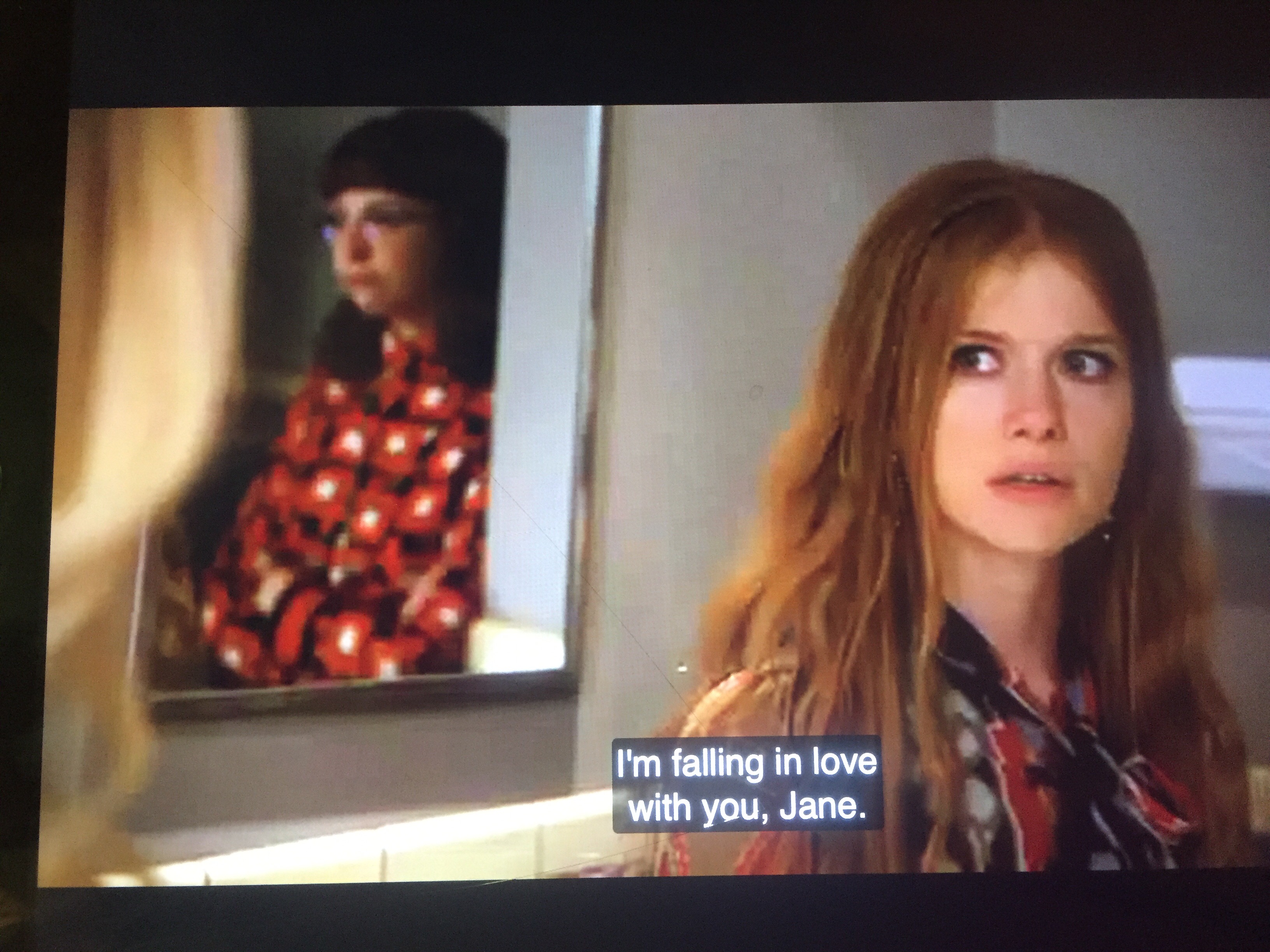
I think we can all agree with Patti’s reaction in Episode 10, after Jane has finally gotten on board and even evokes karma for the cause.

Good Girls Revolt isn’t the greatest show ever made, but it was entertaining enough for me to binge the whole season on Amazon this weekend. Patti is a fun, charming character, Anna Camp is on-point as the exquisite Jane, and Cindy is super annoying–I guess there always has to be one of those girls in every ensemble cast because it gives her the most room for growth (looking at you, Charlotte York MacDougal Goldenblatt).

GGR is based on a book about the true story of the women at Newsweek, so there’s not much new to cover. There were a few smaller moments, though, that seemed both fresh and relatable:

1. Patti’s fear that she won’t be any good.

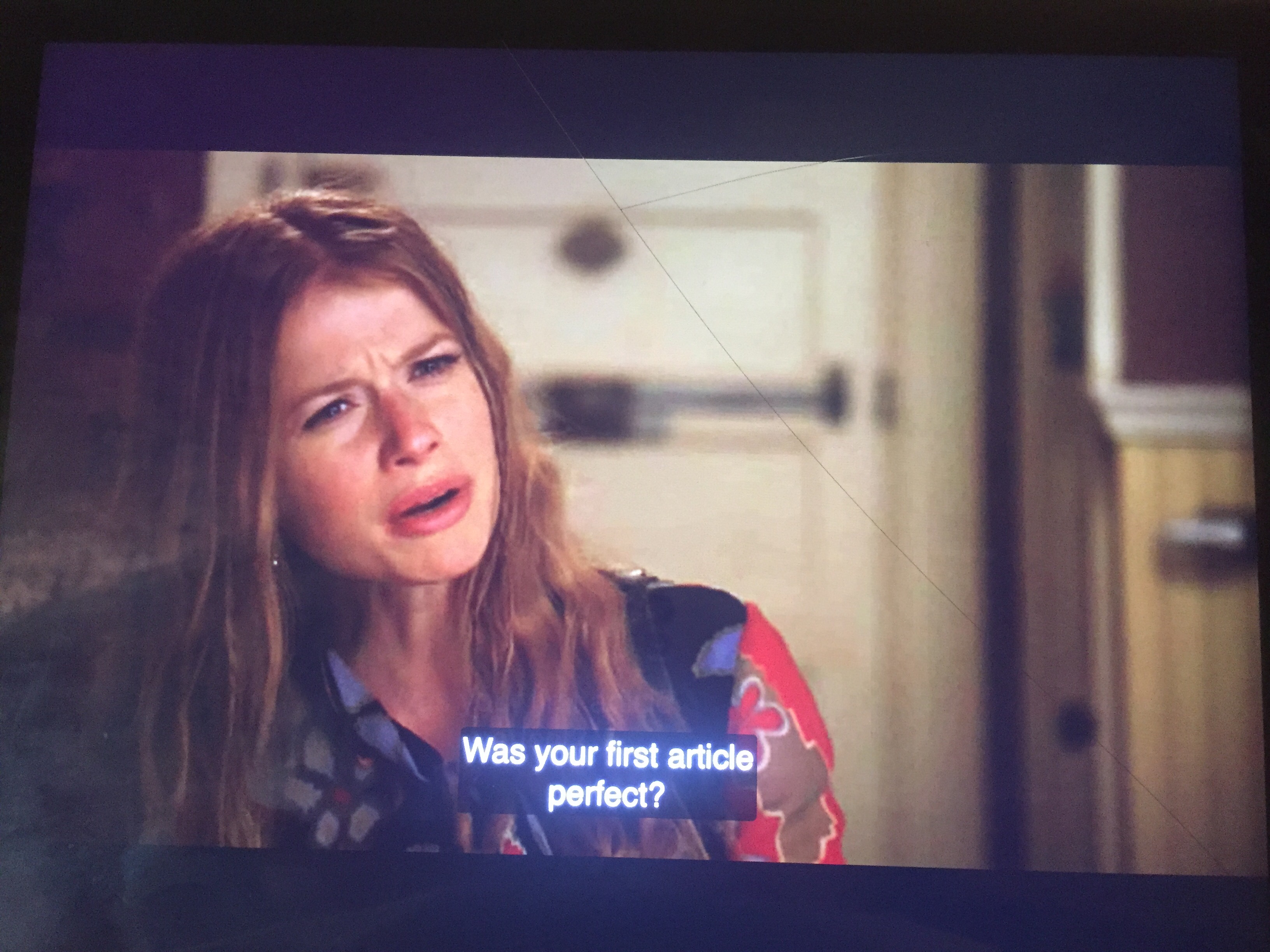
“Was your first article perfect? Huh? Or did some researcher catch all of your mistakes, proof-read you, make you look brilliant. And by the way, even if my copy had been perfect, I still wouldn’t have gotten a byline.”

Remember that scene in 30 Rock when high school age Liz Lemon completely botches a field goal for the football team, raises her arms victoriously, and yells “Feminism!”? She’s a female on the football team but sucks so hard that even her parents won’t watch her play. That’s the undercurrent of fear running through the women’s movement, albeit comedically illustrated.

When Patti completely misses the social services angle on her graffiti artist story, Doug steps in, saying “You can’t just write about what you want.” Later, in episode 10, he tells her, “You screwed that up and you know it.” She shoots back, “Was your first article perfect?”

It comes up again for Jane when another reporter, although female, is hired from outside the magazine to write the women’s movement story Jane pitched to Gregory (after stealing it from Patti). I think Cindy is the one who asks how they are supposed to get writing experience when they are working at a magazine that won’t let them write.

2. Cindy’s Love Story-inspired death fantasies.

cindy

Cindy and Jane share some girl talk over drinks, and since everybody appears to be reading Erich Segal’s Love Story in the early months of 1970, it becomes a segue into talking about the deaths they have imagined.

Cindy makes clear that she doesn’t want to see Lenny or Ned die, but can’t help thinking about the freedom it would give her. It has very little to do with the persons of Lenny and Ned; it is about removing them as factors in her life. Just taking them out of the equation entirely would make her life her own. Jane has similar thoughts about her parents.

3. Wick’s stake in News of the Week.

“You know I have a lot of respect for the institution that gave me my career.”

Wick comes out of nowhere in episode 10 to warn Finn about trouble brewing at the magazine. It was a red herring in the plot structure of the show since he wasn’t trying to tell Finn about the lawsuit. Instead, he explained something that had been alluded to with the Stingray rental and story on Ralph Nader: Gregory was selling favorable coverage to the Big Three.

Wick should be happy to see Finn and News of the Week implode, but he’s looking at the bigger picture: “You know, Finn, I got 30 years at News of the Week. Now, if this magazine goes down as a useless rag that sold its soul out for ad buys, people look at me differently, as if it was going on the whole time.”

It’s the same slightly self-serving rationale that gets me to donate money to my alma mater every year: it “adds value” to the pedigree. By making sure those institutions take care of their reputations, Wick and I ensure our own.

A note about Finn Woodhouse, Editor at Large

Evan Phinnaeus Woodhouse is portrayed by Chris Diamantopoulos, who, for me, can only ever be the Tres Commas Tequila guy from Silicon Valley. But forgetting his prior roles (also finally saw him in the last season of The Office) there is something about his character that is driving me absolutely insane.

Why on earth is Finn’s title “Editor at Large“??? It makes no sense. He’s clearly Editor in Chief. His responsibilities at the magazine are way too extensive for an at-large editor. He “dusts off” his press pass to write the ‘Nam story, but his day-to-day duties are concerned with running the magazine, which is not what an editor at large does.

It sounds so bizarre when he goes on a rant about how the staff should listen to him because he is EDITOR AT LARGE FOR NEWS OF THE WEEK. Just imagine a real editor at large gliding into the newsroom and telling people how to run things. That’s not how it works. Editors at large contribute to the content of a publication; they do not decide the editorial direction or concern themselves with advertisers.

I’m wondering if the nomenclature has shifted since the 70s or if the showrunners got something wrong because it is just too weird. As an example using fairly current magazine celebrities: André Leon Talley was an editor at large for Vogue and Anna Wintour was Editor in Chief. So just imagine that dynamic to understand how weird it is for Finn to scream his title at people when that title is so obviously wrong. This is really freaking me out.

*An earlier version of this post rendered Tres as Trés, in both the headline in the body of the text. While I think it’s funny that I accidentally substituted the French “very” for the Spanish “three,” it was entirely unintentional. This blog’s editor at large regrets the error.

Hindsight and Spoilers

I’ve been watching the new VH1 show Hindsight, which is the long-awaited American version of Being Erica, a top-three television program for me. I was struggling with the 9pm airtime, but this week they switched to an 8pm time slot. This doesn’t work either, because it pits Hindsight against Modern Family. So I recorded tonight’s episode, which had previews that promised tragedy… and some dick just posted a spoiler on Pinterest. White girl problems.

Hindsight and Deja Vu

Being Erica aired on Canadian TV from 2009-2011. I watched it on SoapNet and on YouTube and waited for the rumored American version, which has finally started airing on VH1 in 2015. [*I wrote this in 2015. The show has since been canceled]

Here’s what Erica and Becca have in common: they both work in publishing, their parents divorced after the children were grown, and they each have a troubled brother.

One major difference: Erica goes back and forth, from present to past (and once or twice, the future), while Becca has gone back once, to 1995, and stays there. Erica has “sessions” with her “therapist,” Dr. Tom, who has a philosophical quote for every episode, while Becca’s mysterious stranger has yet to explain himself, and his one Zen koan turned out to be a sign hanging in a bar.

Being Erica was filmed in Toronto, which was pretty awesome. Hindsight has the cute little peach logo at the end, shared by Archer and The Walking Dead, proclaiming “Made in Georgia.” Turns out, Hindsight was filmed in Atlanta but set in New York City… which is less awesome. Tons of shows and movies film in NYC; having another city stand in for it seems like another throwback to the 90s.

Becca is always wearing a Michigan sweatshirt, which has yet to be explained, but Erica earned her BA and MA at the University of Toronto. Hindsight‘s theme song (“In the Meantime” by Spacehog) beats the crap out of Erica’s theme song (a girly Lily Frost song produced specifically for the show).

The most interesting character in Hindsight is Becca’s best friend and roommate, Lolly. The two of them have their own “secret language of movie quotes” (some favorites so far: “I carried a watermelon,” and “A best friend’s work is never done.”) Lolly works in a video store, thinks the cancellation of My So-Called Life was the worst thing that ever happened, and argues that not taking muscle relaxers on your wedding days is the most important lesson learned from Sixteen Candles.

When Becca travels from 2015 to 1995, she is in an elevator. The buttons light up to countdown 10…9…8… and she is flashing back to New Year’s Eve, 1993/4, when she turns to Lolly and says: “I have to tell you something.” Then she wakes up on her (first) wedding day, which is October of 1995. No clue why an event two years earlier is triggering the time travel, hope that gets explained.

The Irish tie-in: one of Erica’s three major love interests is Irish (he shows up in Season Three). Becca’s first wedding, in 1995, took place at “St. John Ireland Church” in Manhattan (St. Patrick’s). In the second episode, the new author whose manuscript comes through Becca’s publishing company, who Becca knows will become a superstar in “fusion philanthropy,” talks about hanging out with Bono while at a writer’s retreat in Kilkenny and teaching the occasional seminar at Trinity College.

A few other things: Becca looks like a cross between Shakira and Sienna Miller, her dad eating Moo Goo Gai Pan (in the 90s) makes me very happy, as does “Where’s the Keurig?” and Lollypalooza, and Anthony from Sex and the City as Becca’s horrible boss, Simon, who barks orders with the preface “Simon says….”

8 p.m., Sunday evening.

For the better part of six years, from 1998 to 2004, I sat down in front of the TV to watch Sex and the City every Sunday at 8 p.m. I turned down an invitation to dinner and a movie; I once let a friend who had broken up with her boyfriend (yet again) wait until after the show was over before I drove to her apartment to hug and console her. During the first part of Season Five, I was on a semester abroad in London and as a result, I am still disoriented about the season I had to watch out of order, in reruns.

I was 16 when I discovered the show on HBO, and 21 when it ended, the year I graduated college. I remember saying at the time: “I’m ready for it to be over, so it will release the hold it has on my life.”

Now that the movie comes out on May 30, I felt I had to do a little something to prepare. With seven weeks to go before the release, I’ve been doing a little research. The idea is to watch a season each week, as sort of a refresher course before I see the movie.

Over the past week, I’ve been rereading the book that spawned the show, a collection of Candace Bushnell’s Sex and the City columns from the New York Observer. There was a bit of a snafu, as I tore my house apart looking for my copy of the book, relented and bought a new used one at Half-Price, then found the old copy in a box marked Miscellaneous from the house move four months ago. (I have a very Carrie approach to housekeeping.)

After I started watching the show in high school, I read the book and hated it. I thought it was gossipy and vicious. There’s a term Bushnell uses, “nasty little cat,” that really sums up the attitude of the book. If this is Manhattan, I thought, then I want no part of it.

Upon a reread, I’m still not a fan of the book, although I found it funnier this time around. It’s been nearly ten years since the first time I read it, and the adult situations and humor are a bit more apparent now. Still, it frustrates me that this is the kind of thing that comes out of New York, the sort of “insider joke” that tries extra hard to exclude the uninitiated. “You don’t understand? Tough. We’re too important to possibly explain it to you.”

Here’s a shocking fact: Candace Bushnell turns 50 on December 1. I just find that jaw-dropping. A little digging on her turned up that she attended Rice in the seventies, dropped out, moved to New York, and began covering the Studio 54 scene. She had wanted to be an actress, but instead landed a plum little beat as a journalist, the Sex and the City column. (Bet she never had to chase an ambulance.) Still, after my little social performance last night, I’m pretty sure bar-hopping six nights a week for your job is actually hard work.

Parts of the book are heart-breakingly honest, like when Bushnell’s alter ego Carrie recalls her days of sleeping on the floor of her apartment with a mink coat covering her, or when she buys some pizza for down-trodden playgirl of the western world Amalita in a seedy part of town, which turns out to be the same neighborhood Carrie lived in when she was broke.

The Carrie alter ego is introduced in a strange way: the narrator and Carrie appear to be two different people involved in the same conversation. At one point, I thought another character with a C-name, Chloe, was being introduced in this way, but later in the book she gets married and so can’t be Bushnell, who got married in 2002. By the end of the book, the narrator has faded to a non-participant, and Carrie’s story has taken over.

Most of that story revolves around Mr. Big, who we know is magazine publisher Ron Galotti. I remember reading an article in New York magazine (online) about the real Mr. Big moving to Vermont with his wife. In it, his wife said something about finding the ex-girlfriend’s (Bushnell’s) clothes in the back of Mr. Big’s closet, and they were all size 0.

The thing about the New York story that stuck out to me was when the writer quipped that people in Manhattan have the sense that anyone who lives any where else must, surely, be joking. I found that article again a few days ago, and realized that one little memorable bit of observation was really a paraphrased John Updike quote.

So snotty. And yet, reading Sex and the City, this toothless, slack-jawed yokel can’t help thinking that people who live in Manhattan — and take the scene seriously — are the ones with issues. Really, this book reads like a bad high school drama; there are cliques and back-stabbing and drunk people trying to get laid.

That was a bitter pill to swallow, back in the late nineties, when I had already been hooked by the dazzle of the show and made the mistake of reading this seedy, superficial trash. I wanted to forget about high school, not find out the real world was exactly the same. At the time, I didn’t understand that I was supposed to look beyond the stories themselves, and perhaps even feel sorry for the players and their silly little lives. Now that I’m old enough to catch a glimpse of the true meaning behind the book, I can’t do it. Candace Bushnell ruined the Big Apple for me, and I still hold that grudge.

Yes, like every teenage girl in rural America, I had that dream of moving to Manhattan and being somebody. I read Vogue not for the fashion, but for the society, that world of luxury that somehow did not seem real. I think the popularity of the SATC television show wasn’t based on the socio-sexual commentary or even the sex itself (watch the show in a room with other people, and see if some eyes don’t shift away from the television screen whenever Samantha is performing whatever ridiculous act was scripted for her in that episode). I don’t think that was the appeal for my twenty-something female peers, anyway.

Producers of the show tried to spin the city as the fifth character on the show, and I think that is the true draw. At least for me, watching Sex and the City every week was like an escape hatch, a reimagining of the Mary Tyler Moore scenario.

I say Mary Tyler Moore, although I’ve never seen that show, because it’s often referenced on the internet when people are critiquing Sex and the City. It’s code for that classic fantasy, the same one that got me hooked on the show in the first place. The characters on SATC were too old to fill the “young girl in Manhattan” role, but I almost think that is why it worked. You could watch them mess up their lives and think, “When I get there, I’ll do it differently.” Manhattan, really, is the whole point of the column/book/show/movie jauggernaut.

On page two of the book and minutes into the pilot episode of the show, we’re treated to this steamer about life in Manhattan:

“No one has breakfast at Tiffany’s, and no one has affairs to remember — instead, we have breakfast at 7 a.m. and affairs we try to forget as quickly as possible.”

I never liked this statement, and it pisses me off that it’s one of the lines that was transplanted, verbatim, into the show. The 7 a.m. joke — not clever. How about “breakfast in a cab and affairs with the hired help?” Saying that New Yorkers eat breakfast in the morning and have bad relationships is not very insightful or funny. But maybe putting effort into your pop culture riffs is just not chic.

What infuriates me even more is that further down the page (and this part was thankfully left out of the show), Bushnell says that Truman Capote understood the nineties dilemma and wrote about it in Breakfast at Tiffany’s. Then she goes on to outline the plot of the movie, not the book. It’s highly disrespectful from one writer to another, especially when she owes her success to an update of the Breakfast at Tiffany’s story. Bushnell probably knows how it feels now, when people reference Sarah Jessica Parker’s show when talking about her creation.

Truman Capote had nothing to do with Paul Varjak, a kept man, and Holly Golightly, a kept woman, forsaking money and finding love with each other, as Bushnell would have us believe. That is what happened in the movie, and Capote said in an interview that he was not happy with the changes or the star of the film. In the book, the “Paul Varjak” character does not have a name, and he is not a kept man. He is a writer, possibly gay, and possibly Capote himself. And in the end, they don’t find love together with the cat sandwiched between them.

I watched the movie again as part of my “research,” and started to reread the Breakfast at Tiffany’s novella, but honestly I’ve read it so many times that I know it backwards and forwards. I can’t even begin to explain how much I love the book and how much I dislike the movie. I think the movie, with its garish colors and horrible early-sixties setting, owes its success to the simple back story of Lulamae Barnes making it from Tulip, Texas to NYC. It certainly has nothing to do with Mickey Rooney’s racially offensive Mr. Yunioshi or that goofy shoplifting scene.

The only part of the film I can stomach is the opening credits, when Holly Golightly gets out of a cab at 6 a.m. in front of Tiffany’s to actually have breakfast (a to-go coffee and some sort of pastry) in her evening gown. I can handle her raised eyebrows at the sight of something really shiny in the Tiffany shop windows, but the second Audrey Hepburn begins to act, I’m done.

The show also recognized its debt to Breakfast at Tiffany’s, as evidenced by Carrie and BIg slow dancing to Moon River on his last night in New York. I’m not a big fan of the song (in the book, she sings the songs from Oklahoma! and something with the lyrics “don’t wanna sleep, don’t wanna die, just wanna go a-travelin’ through the pastures of the sky”), but it appears that the writers of the show at least have enough sense to not mix up the book and the movie. Seriously, it’s like referring to Frankenstein when you mean Frankenstein’s monster.

In the last chapter of the Sex and the City book, Carrie tells Samantha Jones that she is working on her own project, which I think is referencing the book. Samantha tells her it’s a cute idea, but it’s not Tolstoy. I always wondered how that worked in the show and in real life for Bushnell; was she completely candid with her life and the people she interacted with got to read about themselves in her column? Mr. Big could just open his paper and get her take on their latest argument. How do you maintain a relationship that way? Bloggers are one thing, but this column was actually read by a lot of people who knew the couple. With the show, is everything in the voiceover supposed to serve as the column?

Week Two

I need to confess, I’m already annoyed with this project of mine. I have gone the way of Claudia’s Room (a very funny blog about Baby Sitter’s Club books that has tanked in the past few months), but for me, this is only Week Two.

However, I had a complex as a child where I never finished anything I started, and a sort of personality over-correction as an adult has led me to pursue some very stupid commitments to the dogged end (see Romantic Relationships: 2001-2005).

So, on with the show.

I think the best way to handle this is to break down each season episode by episode. One critique about last week’s posting involved the cumbersome length, so I’m hoping these bite-sized morsels will satisfy.

Once upon a time, an English journalist came to New York.

Episode One: sex and the city (Pilot episode)

At first, you’d be tempted to think this is a show about said English journalist. It is not. Elizabeth, whose name was Charlotte in the book, never appears again, though she’s quite likable. A side note: Kim Catrall was born in Liverpool.

In the book, Charlotte/Elizabeth reads a little too much into her relationship. The bit about meeting his mum and him telling the realtor they don’t have kids…yet? That was all added into the show. In the book, the bastard is much less manipulative.

We go through the entire opening segment without seeing Carrie — just the back of her head as Elizabeth tells her story. Then Carrie stubs out her cigarette, signaling that this is not a show where women whine about the way men treat them.

But it is. That’s exactly what Miranda, Charlotte, Samantha and Carrie do the moment we first see them together, at Miranda’s drag queen birthday. And they will be doing that for six more years.

A word about appearances. Samantha’s hair is too long; that is promptly taken care of in the next episode. Charlotte is pretty much the same, and it seems to have taken the costume designers all season to figure out that the tie-wearing, severe hair cut Miranda was not a sympathetic character.

The main overhaul was Sarah Jessica Parker: she’s brunette, with short, frizzy hair and way too much eye makeup (although I have to say, they put glitter eye shadow on her for the rest of the season, and I’m not a big fan of that either. But it was 1998; I was probably wearing it too.)

The biggest mistake for costuming Pilot-Episode Carrie is that she wears leopard print not once, but twice in a single episode. I always thought Carrie had a some-what trashy look about her (“ghetto gold,” smoking, very visible dark roots), but the pilot episode really makes her look like a hooker. I still think leopard print can only be worn ironically.

Carrie also lives in a different apartment for the first episode. I’ve been paying a lot of attention to location this time around, mostly because the question I got wrong on the Sex and the City quiz was: What is Carrie’s apartment number? Still don’t know, but Charlotte lives somewhere near 4th and Bank.

There are also a lot of “interviews” in this episode, which is something that will become less and less frequent until it entirely drops out of the show. I will try to catch the point when it happens. Carrie is really in journalist-mode for this episode, and she says that she has really great sources for her columns: her friends. Not sure that’s very professional, but she does have a unique beat to cover.

Oh, and this episode is the origin of the “abso-fuckin-lutely” phrase.

I'm really very literary. I'll sit down and read a whole magazine, cover to cover.

Episode Two: models and mortals

People like to make fun of Sarah Jessica Parker’s nose, especially males who like to make fun of females who watch the show. As if she didn’t know it was huge and thus should be admired for overcoming and making a career with her face.

For that reason, I love this episode, because it makes two disparaging references to SJP’s nose. The first is when the girls are comparing the body parts they hate and Carrie points to her nose, and the second is when Derek a.k.a. the Bone says Carrie’s nose is distracting him. The scene with the Bone, surprisingly, comes straight from the book, but the trading body flaws talk with the girls seems to be written for SJP. So there.

I also like the throw-away joke in the party scene, when all the models are wrinkling their noses and turning away the hors d’orvs and Carrie scoops four of them off the waiter’s tray.

This leads to another encounter with Mr. Big, and in both this episode and the first, he seems to be adamant about taking the wind out of Carrie’s sails. Her column is “cute,” men who date models are “lucky,” and everything about her fluffy little world that gets whipped up throughout the episode is brought down to earth with a loud thump the second he shows up and says something snide.

One might think that I don’t like Mr. Big, and one would be right up until this point in the show’s history. I really have a love-hate relationship with the man. To quote SJP: “Chris has done a great job of taking a very specific archetype of man and forcing Big to become human.” (See Sex and the City: Kiss and Tell).

Case in point: my all-time favorite moment of TV history is the final scene of this episode. Carrie has told BIg that she sometimes writes her column at a coffee shop on 73rd and Madison (which she will never do again after this season). He comes to see her there, and the first thing I love about this scene is that Big does not read over her shoulder when he walks up behind her while she’s writing on her laptop. Aidan does this in a much later episode, and it drives Carrie (and me) crazy.

Big sits down across from her, and suddenly, I love him. He starts off saying he’s late for a meeting (ooh, so powerful), but he’s been thinking about the column she’s writing (okay, so you were glib at first but it actually gave you some food for thought, huh Mr. Big?). Then he says “well, there are so many goddamn gorgeous women out there in this city,” which pisses Carrie off but is actually kind of sexy because that “goddamn” shows more emotion than anything the character has said so far.

Then he says: “but the thing is this: after a while, you just want to be with the one who makes you laugh, you know what I mean?” And Carrie grins and nods, and he leaves, and then the voice over makes some Manhattan-specific quip, and then it’s over. But I love it. That line was inscribed in silver ink on the back page of my “senior memories” book in high school.

Samantha gave me a look like I had sold her to the enemy for chocolate bars and nylons.

Episode Three: bay of married pigs

Okay, I’m mostly going to skip over this episode because it tries to discuss an issue that is tackled more effectively later in this season. Episode Three is all about “the cold war between marrieds and singles,” which, if you watch carefully, is really just a rivalry between married women and single women. For that conversation, we are all better off watching Episode Ten, “The Baby Shower,” which I will discuss, with relish, further down the page.

However, there is something about this episode that I have to write about, and it really only comes into play at the very end. Charlotte makes Samantha sleep over because she’s been shooting Tequila all night at a married couples party. Samantha makes a play for Charlotte’s doorman, who has a British/Scottish/Irish accent. It must be Irish, because that would explain the “summary statement” the voiceover makes at the end of the show/column. Plus, he says “Jaysus.”

“Maybe the fight between marrieds and singles is like the war in Northern Ireland,” Carrie says in her head as she walks to the movie theatre. “We’re all basically the same, but somehow we wound up on different sides.” Wouldn’t the Civil War be a better simile here? I just don’t think the war in Northern Ireland can be explained away that easily (I know I haven’t been able to do it.) Even more confounding is the fade-in of Aretha Franklin’s “Respect.” What the hell does that have to do with anything?

I've been looking all over for you, and here you are, holding a tongue.

Episode Four: valley of the twenty-something guys

Ahh, Twenty-Something Sam, my second favorite of Carrie’s single-episode boyfriends (ergo Big, Aidan, Berger, Aleksandr, and the peeing politician do not count, because they were in multiple episodes). This would be Timothy Olyphant, from Gone in Sixty Seconds, Scream 2, First Wives Club (with SJP) and, according to imdb.com, Deadwood. Okay, this is really embarrassing, but I never realized that was him in the lead role. Whoops.

This episode also starts “Once upon at time…” but then goes in to Carrie and Big’s story. She keeps comparing him to a crossword puzzle, which I like. “Men in their forties are like the New York Times Sunday crossword puzzle: tricky, complicated, and you’re never really sure you got the right answer.”

I guess they’re contrasting this with Twenty-Something Sam, who is constantly compared to an addictive drug. “Yes, Samantha, Miranda and I were all recreational users,” Carrie says, and “Why the sudden craving?” It’s funny, because Sam’s twenty-something dialog, especially when he’s recounting his Unicorn Woman dream to Carrie, is something you don’t get to hear a lot on SATC.

Oh, this episode also has the “Mrs. Up the Butt” conversation. Supposedly it is a landmark conversation with the four of them in the back of that cab, but I think they are a bit too hysterical (in the high-strung sense, not the funny sense) about the whole topic.