Networking is yuppiespeak for “talking to people.” Some people do it well, some people do it poorly, and some don’t do at all. One of the reasons I have risen in the ranks of the Local Yuppie organization is my ability to talk to people–because sometimes it seems like I’m the only one willing to do that.
I’m not even that good at it. I was an extremely shy kid, but Ireland cast a spell on me and now I have the ability to hold a conversation with anyone. Yes, I have kissed the Blarney Stone, which sure and begorrah has given me the gift of gab, but the true credit belongs to the Irish pub, where I learned how to talk to anybody and everybody.
One of my biggest complaints about the Local Yuppie organization is that they can be a little cliquey. I remember when I first started coming to events, before I had actually joined, how difficult it was to even identify the members of the board, let alone get them to talk to me. Some of them were outright hostile. I actually enjoy getting under people’s skin, so rather than scare me off, that actually motivated me to get more involved. There were a few events where I showed up just to see how badly I could piss off the ones that clearly didn’t like me.
All this, and now they want me to be president. Not because I’m the best person for the job, but because they didn’t build a sustainable organization and now no one wants to run it. I’ve heard other young people in the community complain about feeling unwelcome in the organization, and I know it’s true because they did the same thing to me at first. For people who are less contrarian than me, that’s a total turnoff. The organization doesn’t grow because most people don’t choose to hang out with assholes in their free time. We get enough of that at work.
An issue came up a while back that has been a problem before: when to hyphenate?
My issue was with the word fund-raising, used as a noun (although that may not make a difference). I prefer the more modern “fundraising”–so do the New York Times and the Associated Press–but I need a better reason than “it sounds old fashioned” to justify the edit. Gregg’s manual suggest treating compound nouns as two words unless the dictionary says otherwise, and lists fund-raising as a hyphenated example. It looks like nonprofits frequently argue over this term as well.
Grammar Girl, my go-to guru, has focused her hyphenation podcasts mostly on adjectives, such as the time CNBC ticker writers appeared to be squabbling over the issue: “Is the glass half full or half-empty?” In this case, no, you do not have to hyphenate, but she is sure to emphasize that there are many exceptions to the rules of hyphenation.
Compound modifiers are often compound adjectives, like you are applying the adjective as a single unit to a noun. And it’s important to ask: will the hyphen, or lack thereof, affect your meaning? If you’re feeling wrinkly, you may need to re-press your jeans, not repress them like bad memories.
The terms designated in Gregg’s are “hyphenated,” “spaced,” and “solid.” Solid is my favorite descriptor of a word, and it’s the one I’m trying to push for fundraising.
Other words I’ve had questions about were heads-up, clean-up, proof-reading and copy-editing (the title of one of my graduate courses) and, a bizarre attribute that came up in a tipsy conversation: odor-aware.
“I’m really very literary. I’ll sit down and read a whole magazine, cover to cover.”
Sarah Jessica Parker just announced the first book she will publish for her SJP for Hogarth imprint. This is not the first time a celebrity has gotten her own publishing imprint. Lena Dunham’s launched last year, and a quick search reveals Gwyneth Paltrow, Johnny Depp, and Oprah Winfrey all have their own imprints. I’d read about Derek Jeter’s around the time he retired, and am not surprised to see Anthony Bourdain has one as well. There’s lots of commentary out there about how boutique publishing is now just part of a celebrity brand. You prove yourself to be a tastemaker and a thought leader.
I am still wanting to see the day Jessa Crispin gets her own imprint. It doesn’t seem like something that would interest her, but I’ve always imagined her somehow infiltrating the system, planting herself in a corner office with a bottomless budget, and publishing really weird shit while drinking whiskey and smoking a cigar with her heels up on the desk.
That’s not really what sells books, I guess, and the publishing industry as I always imagined it doesn’t exist anymore. The story goes, it was a gentleman’s game that permitted women to while away some time until they got married, everybody enjoying three-martini lunches until Amazon came along and spoiled all the fun. I don’t know for sure; I wasn’t there, and I’ll never get the chance to find out.
Still, we got books out of the deal. The business of books has always baffled me. A mentor-type who has had a long career in finance asked me about work the other day, so I babbled on a bit about ebooks and sales and not knowing how to price anything and then he commented, “It’s fascinating to follow a market, isn’t it?” That comment cracked open something in my head. Books are a market, like any other. Volatile, subject to whims, and vulnerable to outside influences. It’s art, yes, and I’ve always known that, but even fine art has a market.
Exploring the intersection between the two is what took me to grad school. The program was a masters in literature and publishing, for heaven’s sake. Literature and publishing. Art and commerce. Does what it says on the tin.
Four years later and I’m still sitting here, twiddling my thumbs because I’m just NOT SURE. I still don’t know what all this means. It’s my writing style to a T: do a bunch of reading and research and throw a few interviews into the mix but never get to the bloody point. If I were to take a step back and apply the lessons I’ve learned in journalism, the obvious question to attack would be “How does one get rich through books?”
[*I wrote this post in January and just now found it in my drafts.]
My New Year’s Resolution (besides quitting smoking) was to fail spectacularly at something every week. The idea was to inoculate myself against a fear of failure while simultaneously forcing myself out of my comfort zone.
The fact that I struggled to remember what the Week One failure had been was in itself a lesson in letting go. But I went through emails, texts, and calendars until my browser history jogged my memory.
Week One:
Tweeted at Jenny Bicks, Sex and the City writer, and panicked/rejoiced so much when she responded that I didn’t read her tweet closely and answered the wrong question.
Week Two:
Got rejected for a job (didn’t even land an interview) by a nonprofit the same day I had tickets to attend one of their fundraisers, so I got to see the person who wrote the rejection email and the person I would have been assisting basking in their smug, cool job glory.
Week Three:
Got bamboozled into buying new tires for my car after having a blowout. Was so puffed up on the fact that I’d changed the tire by myself that I neglected to practice smart consumerism and marched in there ready to spend $800.
I attended Jessa Crispin’s reading at BookPeople on May 11. I’ve always been a fan of Crispin and had just finished Why I am Not a Feminist: A Feminist Manifesto that day.
The audience, mostly female and younger than I had expected, listened as Crispin read aloud some critiques of the book and responded. She then took questions, one of which essentially asked what entertainment do you find acceptable? (One of the more quotable quotes from the book calls modern feminism “a decade-long conversation about which television show is a good television show and which television show is a bad television show.” Which is hilarious.)
It came out that Jessa Crispin does not consider Buffy the Vampire Slayer feminist, mainly due to the savior complex that plagues every superhero movie. She then joked that she could feel the audience turning against her and quickly changed the subject.
Since I just finished watching Buffy in its entirety for the first time, I was part of the wave of support for the feminist reading, which I admit did not sit well with me until the Beer Bad episode. [Spoilers follow.]
I. Beer Bad
Everyone hates Beer Bad; I thought it was hilarious. Not gonna lie, what screamed “feminist” about this episode for me was the cave slayer clubbing a dude over the head. Up until this point (and this is Season Four) I hadn’t really gotten the feminist vibe from the show. Yes, Buffy was a female hero and kicked ass and did it all 20 years ago, but her movie counterpart had done the same thing five years earlier. (I was a huge fan of movie Buffy. I dressed as her for Halloween when I was 10 years old. I drew my girl power from Kristy Swanson.) I really enjoyed Sarah Michelle Gellar’s acting in this one, though. She always got to do a lot of physical stuff as Buffy, yes, but the body movement here was different and showcased her range.
Buffy’s first college relationship was a bad one. A shitty, stupid situation in which we have all unfortunately found ourselves at one time or another, made worse by the fact that she just couldn’t get over him. Parker’s douchebag behavior does give Riley an excuse to punch him, which is awesome. (I also like Riley. A lot. I cried when he helicoptered away from Buffy and I hate that people hate on him. He’s the Aiden–you haters realize that, right?)
But before Riley clocks Parker in Episode 4:7, Buffy gets a shot at him in Episode 4:5 and I don’t know why, it just worked for me. Must have appealed to my troglodyte instincts. Plus, there’s a craft beer theme (in 1999, no less). Foamy!
II. Power
Here’s the thing: wherever you are in your feminist journey, keep going. Some of us are further along than others. Case in point: I’m 34 and I just figured this out. Buffy was 20 years old when she learned that she was the one with the real power.
Power. I have it. They don’t.
This bothers them. It’s why they attack you and try to make you feel inadequate–because they are afraid you may realize that they need you more than you need them. And the day you figure that out, you’ll be free. It’s not the same as Buffy undergoing the council’s impossible review, but when you quit participating in the systems that oppress you, you’ll see how badly they needed to you to comply.
Bonus: “That’s Riley-speak.”
III. Every Girl
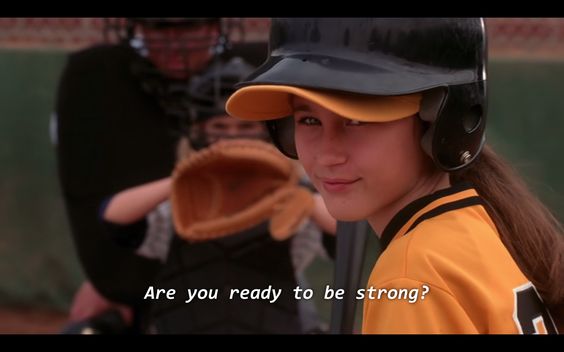
I cried so, so hard at this. And I hated all of the potential slayers. I hated them in the house, I really hated them when they kicked Buffy out of the house, and I was glad when the cockney one died. Still, when every potential slayer in the world got tapped at the same time, I cried like a baby, especially with the little girl at bat.
This is what destroys the savior complex of the show–the idea that it was all leading toward a dispersal of that power, that every one of us could be strong.
As promised, here’s the post on Tony from 13 Reasons Why.
I’d been dragging my feet on this because of other stuff going on in my life (stuff that required me to write a very “terse” email that will live in LY infamy), but the news of Ross Butler leaving Riverdale (a total mistake IMHO*) has inspired me to get moving again. Zach had been one of my favorite characters in 13 Reasons and, in my opinion, he didn’t really deserve a tape. But he is fucking up Riverdale, home of all iconic gingers, in order to remain in the 13 Reasons universe, so he’s now persona non grata for me. With the death of my other favorite 13 Reasons character (no, not Hannah; spoiler in the link) we’re back to the beloved Tony.
Tony Padilla is played by Christian Navarro, a 25-year-old actor of Puerto Rican descent. “Tony has amazing taste,” Hannah says as he spins a school dance. “This song is perfect.” Tony is also an LGBT character, though Clay somehow doesn’t know this and Tony having to tell him he is gay is genuinely funny. Clay also yells at Tony for being an “unhelpful Yoda,” which is a pretty accurate description, but remember Yoda isn’t supposed to be all that helpful at first. He makes you earn it. And Tony repeatedly tells Clay to just listen to the tapes already. Tony is like Clay’s guardian angel, and in a way, he’s Hannah’s avenging angel.
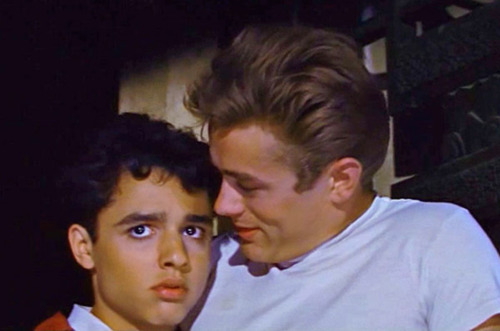
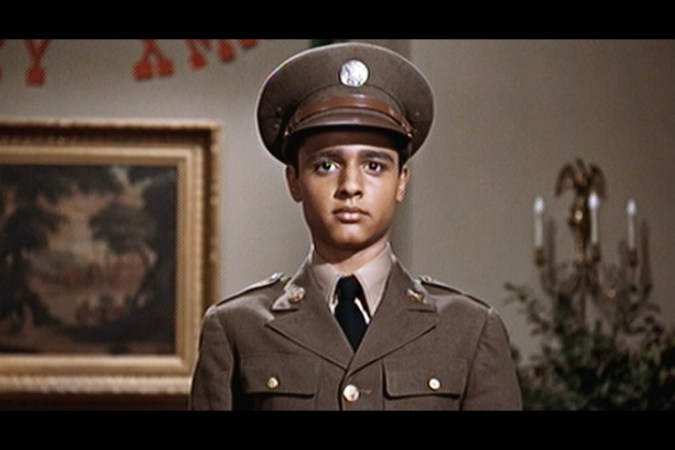
Tony’s storyline does develop, and he has his flaws, too. I just kept thinking how the character seemed to be almost a direct descendant of John “Plato” Crawford in Rebel Without a Cause. The classic tale of teen angst also has an LGBT message, as Plato falls in love with James Dean’s character. The two went on to appear in 1956’s Giant, in which Mineo played a Mexican-American soldier, despite his Sicilian heritage.
I’d hit on this Sal Mineo connection during “Tape 5, Side A” (Episode 9) probably about the time Tony helps Clay skip school, so when Wilson Cruz showed up in “Tape 5, Side B,” I almost fell out of my chair.
Real-life LGBT advocate Wilson Cruz plays the Bakers’ attorney in only two episodes, but all 90s teens remember him as Enrique Vasquez on My So-Called Life. Before Willow and Tara, before the kid from that Dawson’s River show, even before freaking ELLEN, there was Rickie. He struggled with his sexuality while Angela (and the rest of us) lusted after Jordan Catalano, only able to say the words when cheerfully confronted by Delia (played by the wonderful character actress Senta Moses) in the very last episode before the show was canceled:
Delia : Okay, but um, you’re gay, right?
Rickie : Well, I, you know, I, I-
Delia : Oh, I’m sorry. I didn’t-
Rickie : No, it, it, it’s okay.
Delia : That came out so rude.
Rickie : No, uh, see I, I try not to, um, no, I, I don’t like, uh- [throws pencil down] Yeah, I’m gay. I just don’t usually say it like that.
Delia : How do you usually say it?
Rickie : I don’t usually say it. I mean, I’ve actually never said it…out loud.
(Episode 19, “In Dreams Begin Responsibilities”)
With Rickie, as with Plato, the sexual orientation is implied more than it is spoken aloud. Rickie has one of my all-time favorite lines in the Halloween episode when he pulls out Angela’s sweater in the girls’ bathroom and exclaims “Oh, look, mohair!” (I don’t know why, I just always thought that was hilarious.) In every high school in the 90s, there was always the guy who, though not quite ready to come out, dressed sharply and palled around with the girls. In episode 15, which features Juliana Hatfield’s guest appearance as an angel and which I just learned was titled “So-Called Angels,” Angela is freaking out because Rickie hasn’t come to school after her parents wouldn’t let him stay with them. Rayanne, telling her to chill, says:
“Maybe he’s coming in late. Maybe he’s at some Sal Mineo film festival.”
It took me a long time to respect the significance of that line, and it’s such a throw-away that I’m not sure many people ever really did. Because of course Rickie identified with Sal Mineo.
(By the way, A.J. Langer is a countess now. And the characters in both My So-Called Life and 13 Reasons Why attend school at Liberty High.)
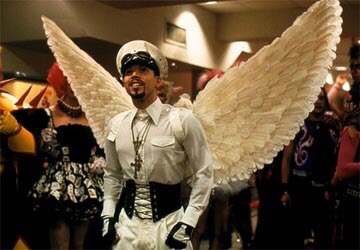
There’s another Wilson Cruz role that has always haunted me, justifiably, because the fate of his character is so gristly. In Party Monster, Macauley Culkin’s Michael Alig makes Angel Melendez deliver drugs around the city in an angel costume. That image of him walking through the deserted city, making his way toward the mayhem in Peter’s hotel room, kept coming back to me every time Tony appeared on screen in 13 Reasons Why. Yes, you’re some sort of angel figure, but guardian angel or avenging angel?
*If played right, this could work in Riverdale‘s favor, and I hope they hit on a brilliant way to recast Reggie. Remember how Shelly Pomroy was played by three different actresses on Veronica Mars? Shelly Pomroy’s party sophomore year was so crucial to the plot of the show that Veronica was still name-checking her in college, but Shelly Pomroy herself was a very minor character and no one really noticed the recasting. They did, however, notice the recasting of Carrie Bishop, played by Leighton Meester in the show and Andrea Estella in the movie. The movie used Carrie’s stage name, Bonnie DeVille, to sort of explain away the transformation, but I always thought it would have been a treat for loyal fans if the murder victim had been Shelly Pomroy instead. That way, when yet another actress was brought in, we would have been in on the joke. Plus, Carrie/Bonnie was too cool of a girlfriend for Logan and I perceive her as more of a threat to his relationship with Veronica, if that makes sense. So if they find a way to riff on the fact that Archie’s great rival Reggie was a non-player in the first season, the recasting could actually be a good thing. I’m still mad at Ross Butler, though.
It’s National Library Week. I’ve had some feedback on my Top Ten Movie Libraries list, so here are a few more explorations into fictional libraries:
Attack of the Clones
One of the reasons I didn’t include the Jedi Library on my list was that I have only seen Episode Two like twice and didn’t want to look like a poser. After a friend clued me in on the Jedi Library’s resemblance to the Trinity College Library, I started watching the movie to remind myself of the context. My boyfriend walked into the living room and said, “Why are we watching the worst Star Wars?” I don’t want to get too deep into all that; just let it suffice that I can’t add the Jedi Library to my personal list of favorite movie libraries because it wouldn’t be true.
Still, the comparison is interesting, and Trinity is one of my favorite real-world libraries, so it’s earned a place on this auxiliary post. The scene occurs mercifully early in the movie, before we get into too much off-putting Anakin/Padme romance. Ewan McGregor is doing some research and winds up in the universe’s repository of knowledge. Lost a planet, Master Obi-Wan has, and when he asks the librarian for help, she gets snippy with him!
This movie, which I’d totally forgotten was adapted for the screen by William Goldman of Princess Bride fame, includes the famous Library of Congress rotunda pull-away shot. This is an iconic library scene, left off my personal list because I’ve never been to the Library of Congress and I had never seen All the President’s Men. Until now. Last week, I followed an internet trail from Janet Cooke to Bob Woodward and ended up finally watching this film. I had so many questions regarding privacy rights as depicted in this film; these bloggers answered many of them:
Cinematically, I’m drawn to the roundness of this shot compared with the all the other squared-off 70s settings, like the opera house or the parking garage where Woodward meets Deep Throat. I especially love the long looks at the newsroom, capacious and laid out in a grid of low cubicles and straight-edged fluorescent lights, which is repeated in the long tracking shots of the District itself, with its city blocks and the right angles of buildings. Most everything in this movie is low and rectangular, except for that reading room rotunda scene, and even within all those concentric circles, we know there are two men flipping through little quadrilateral checkout slips.
Many, many people have pointed out how that scene shows the magnitude of what Woodstein were getting into–they followed a thread through a winding maze that eventually brought down a presidency. I keep snagging on something else, though: how feminine that shot is, in a movie that is almost entirely masculine.
I’ve written before about women in journalism, and Watergate happened two years after the 1970 Newsweek lawsuit. Nora Ephron’s involvement in both Good Girls Revolt and the screenplay of All the President’s Men has raised a few questions for me as well. Maybe it’s the Men in the title, but I just couldn’t help seeing this movie through a feminist lens, despite, or perhaps because of, the fact that it’s a true story. Female characters in this movie have either dated someone who knows something, or they’re acting as cagey sources who are eventually worn down by our intrepid reporters, or they’re the pregnant wife who made Hugh Sloan resign “to spend time with his family.”
The feminist reading pivots on the arrival of Sally Aikens, who has apparently been a reporter at the Post this whole time, but never appeared on screen before now. (This movie has a lot of names and characters; I watched with a notebook and a very active Google search page.) In real life and in Goldman’s original script, Sally was actually Marilyn Berger, a staff writer for The Washington Post. “She’s an awfully good reporter–I can’t remember her getting too much wrong before, can you?” Woodward observes.
When Sally comes forward with information, Woodward flat out asks if the source was trying to get her into bed, and Bernstein asks why it took her so long to effectively betray her lover’s confidence. Her sexuality on the table and her reporter’s chops in question, she looks at Woodward and voices the thought that had dogged me throughout this whole film, a line not in Goldman’s original script but rendered absolutely hilarious by the fact that Woodward’s source is codenamed Deep Throat:
“I guess I don’t have the taste for the jugular you guys have.”
13 Reasons Why
I know, I know. But I’ve been casually counseling a bunch of millennials this week, and this is what they wanted to talk about (they thought the cassette tapes were cool). The narrative structure definitely glamorizes suicide and flirts with the dead girl trope, but the catharsis of Clay’s tape has me shook. You also have to admire the integration of plot points and masterful handling of a huge cast of characters, not to mention the geeky aappreciation for music. I’m not trying to sell anyone on this show but I will have another post featuring beloved campus DJ and guardian angel Tony.
This is also a cheat on my part because we never see the actual library on screen, just this sad little annex at career day in the gym and a community room “safe space” for the poetry group. I just really dug Episode Eight because of the sexy librarian, “campus intellectual” Ryan’s snotty attitude, and the Lost-N-Found Gazette.
Anyway, that’s it for now. Happy National Library Week!
Confession: I am really bad at pitching stories. Always have been. It’s what holds me back as a writer. I could easily tackle my issues with commas and hyphens if I had anything important enough to say, but the narrative drive isn’t there. I’d love to write a book but have no idea what to write about, and my journalism career stalls out when I can’t bring anything to the table.
I once interned at Texas Monthly, and one of the perks is that interns get to attend the pitch meetings. Interns can pitch story ideas as well, and it’s kind of a big deal to have one picked, so when Evan Smith came looking for me to shake my head, I was extremely giddy and had to call my mom. Even so, it was just the generic “I love Veronica Mars and Rob Thomas is from Texas so someone please interview him” story on my pitch sheet, not the other four painstakingly detailed proposals I had carefully crafted. I was not the only one to have suggested a Rob Thomas story, and it eventually became a reality around the same time the Veronica Mars movie did.
For a former journalist, I often wildly miss the point. The last few magazine stories I’ve pitched have fallen flat, except for the one that was picked up by another writer AFTER I had severed my relationship with that publication and totally may have just been the editor thumbing her nose at me.
One of my college professors once wrote a comment on my personal essay: complicated in an uninteresting way. That is me to a T. I tend to overthink things that don’t matter to anyone but me. The thing is, they matter deeply to me. They’re pretty much all I care about, what I spend my time thinking about, and what I write about when I have the choice. No one reads my stuff, but who cares? I’m staying true to myself, right? In the eloquent words of our president: Sad!
Like everyone else in the free world, I’m listening to S-Town right now, and in some way, the meandering story gives me hope. Like, if you stick with something long enough and have enough talent, you’ll someday give it shape and meaning and purpose and people will go nuts over it. But that’s only if you identify with the narrator of S-Town, the podcaster who crafted this story from a huge cast of characters and a range of disparate events that happened over several years, pulling it all into a cohesive seven episodes in a nice studio with some of the most talented people in the business and, oh yeah, a salary.
Sometimes, I identify most with John B., building shrub mazes in my backyard, ruminating over the world’s problems, and never getting anywhere.
Imagination should be used not to escape reality but to create it.
-Free Will Astrology
Today is my last official day volunteering in the library. I will still be helping out with the website and special events, plus I’m on the board of the newly formed Friends group, so it’s not like I’m going anywhere. Still, the weekly commitment to physically staff the library is now a thing of the past.
As a way of saying farewell, and in no particular order except maybe autobiographical, here are my Top Ten Movie Libraries:
Ghostbusters (1984)
“Peter, at 1:40 PM at the main branch of the New York Public Library on Fifth Avenue, ten people witnessed a free floating, full torso, vaporous apparition. It blew books off shelves from twenty feet away and scared the socks off some poor librarian!”
They don’t make them like this anymore. Hadley Freeman has written frequently about her favorite film, full of nostalgia for 1980s “crap science” and the New York of her childhood. Still, those of us who didn’t grow up in New York are right at home with that opening shot and closeup of one of the stone lions, whose name is Fortitude (the other lion on the south side of the steps is named Patience).
JANINE You’re very handy. I can tell. I bet you like to read a lot, too.
EGON
Print is dead.
Beauty and the Beast (1991)
I left the Hogwarts library off this list because it was just too obvious. The animated Beauty and the Beast library is almost as duh-inducing and Disneyfied as Harry Potter, I admit, but I was still a kid when I saw this and can’t dismiss something so formative. I’m not immune to the psychology of Pinterest and this did indeed influence my expectations of men: “I want to do something for her.” It’s as easy as that.
And no, I haven’t seen the live-action version yet, but here’s my post on Emma Watson’s Book Club. Also, check out the Book Fairies:
Most of the movie takes place in the library, which is actually the school’s gym turned into a library set, thus explaining the high ceilings, balconies, and giant modern art sculpture in the center of the room. This movie came out in 1985; I first saw it at my middle school best friend’s house, probably ten years later. I remember at the time experiencing the film as this long, epic Saturday full of teenage pain and the struggle against authority. Now when I watch it, it seems so much less expansive–exactly like high school.
Major League (1989)
The library scene is actually much longer than this, with Rene Russo wearing librarian glasses and screaming “I have a much better body than she does!” in the quiet reading room of what is actually the Northwestern University library in Chicago. Reading through the script and seeing the details of the stewardesses, the paternity suit, and Miss Dairy Queen all stacked up together, I’m a little disappointed in Lynn for taking Jake back, even if he is the true hero of the film. He didn’t even read Moby Dick “cover to cover, babe.” Not really.
LYNN Who saved Ishmael at the end?
TAYLOR
Nobody. It was Queequeg’s coffin.
High Society (1956)
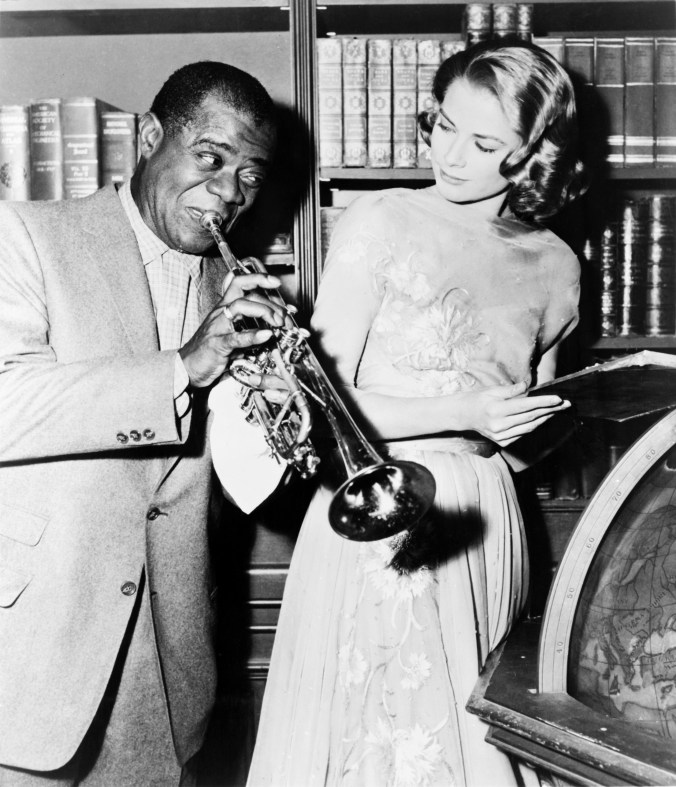
High Society (1956) is my favorite “classic” movie. It’s a remake of The Philadelphia Story, but the cast and the Newport setting make it worth the trouble. The library is the backdrop for two songs: Frank Sinatra crooning You’re Sensational to Grace Kelly during an afternoon tour of “the playground of the rich,” and Frankie teaming up with Bing Crosby for the boozy Well, Did You Evah during her bachelor(ette?) party that evening. I love when the bar pops out of the wall and Sinatra quips: “I had a bed that did that once.” I was also thrilled when Robbie Williams and John Lovett covered Well, Did You Evahback in 2001.
Clue (1985)
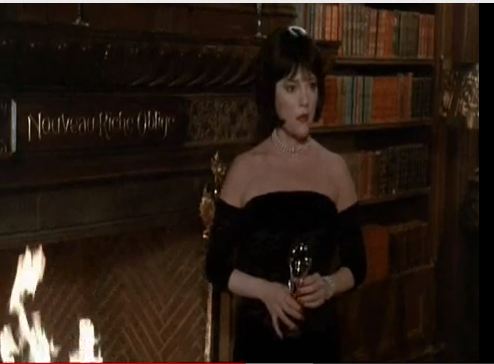
More than any other library on this list, this is the one from which I will be drawing decor inspiration. The Nouveau Riche Oblige fireplace upon which Madeline Kahn exquisitely smashes her wine glass is perfect ornamentation for this film. In the movie’s murder game, the library is where Miss Scarlet kills the cop with a lead pipe while he’s on the phone (twice). The trivia surrounding this box office flop is copious, but here’s something new I just learned: Carrie Fisher was originally cast as Miss Scarlet, but entered rehab right before rehearsals began.
Wings of Desire (1987)
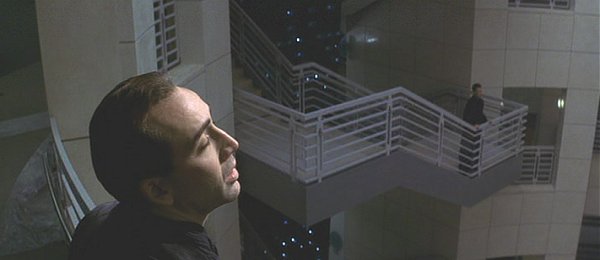
This film’s Hollywood remake City of Angels came out in 1998, when I was a sophomore in high school and just starting to learn about some sort of culture outside my hometown. The world was divided into people who liked being emotionally manipulated by Meg Ryan/Nicolas Cage and those who didn’t. I couldn’t explain why; I didn’t even know it was a remake. A screening of Der Himmel über Berlin in my college German film class helped clarify the issue. For example, one film features the Berlin State Library as a way to access the thoughts of a raw and divided city, while the other shoehorns Hemingway and the San Francisco Public Library into a story ostensibly about Los Angeles.
Harold and Kumar Escape from Guantanamo Bay (2008)
I was ruminating on libraries as romantic settings and remembered this scene, which I’ve always loved. The Square Root of Three is such a sweet little poem, and Harold’s new-wavy goth cameo is just icing on the cake.
The Square Root of Three by David Feinberg
I’m sure that I will always be A lonely number like root three
The three is all that’s good and right, Why must my three keep out of sight Beneath the vicious square root sign, I wish instead I were a nine
For nine could thwart this evil trick, with just some quick arithmetic
I know I’ll never see the sun, as 1.7321 Such is my reality, a sad irrationality
When hark! What is this I see, Another square root of a three
Has quietly come waltzing by, Together now we multiply To form a number we prefer, Rejoicing as an integer
We break free from our mortal bonds With the wave of magic wands
Our square root signs become unglued Your love for me has been renewed
Party Girl (1995)
Sorry about the quality of the video–this movie can be hard to track down. It’s one of those films I reallllly wish I had seen earlier in life. Club kids and Lebanese street food are things I should have been exposed to sooner, and the whole Dewey-Decimal-meets-beats-and-decibels juxtaposition of books and records makes me smile. The movie came out in 1995; I probably didn’t see it until 2012 or so, and I ultimately got around to it because someone used this quote from Mary:
“I would like a nice, powerful, mind-altering substance.
Preferably one that will make my unborn children grow gills.”
Breakfast at Tiffany’s (1961)
And here we are, back where it all started: the 42nd Street Branch of the New York Public Library. Now known as the Stephen A. Schwarzman Building, the Central Building set the scene for many beloved New York stories. Carrie Bradshaw planned an ill-fated wedding there, and her literary predecessor, Holly Golightly, declared “I don’t think this place is half as nice as Tiffany’s.” Patience and Fortitude make an appearance in the original novella, which makes me appreciate the callback in the film:
“Late one afternoon, while waiting for a Fifth Avenue bus, I noticed a taxi stop across the street to let out a girl who ran up the steps of the Forty-second Street public library. She was through the doors before I recognized her, which was pardonable, for Holly and libraries were not an easy association to make. I let curiosity guide me between the lions, debating on the way whether I should admit following her or pretend coincidence. In the end I did neither, but concealed myself some tables away from her in the general reading room, where she sat behind her dark glasses and a fortress of literature she’d gathered at the desk.”
Three Bonus TV Libraries
Buffy the Vampire Slayer (1997-2003)
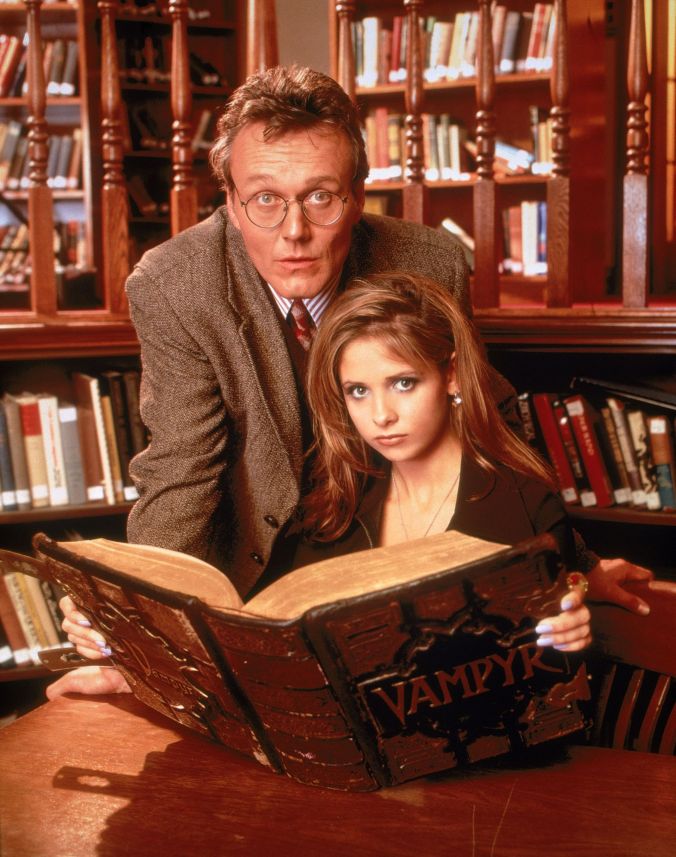
This is a tough one because the library is the literal center of the first three seasons. It was pointless to pull a scene because so many of them take place there. I am new to the Buffyverse and have no right to criticize, but this is probably the worst use of a library in fiction. It serves as a place to either do research or listen to a long expository speech from Giles. I’m reading that the cast and crew hated these scenes because there was nothing to do, and I feel like that is a very cliched dismissal of libraries as dry and boring. Part of the problem was that NO OTHER STUDENTS EVER USED THE LIBRARY. Libraries should be vibrant and vital to the community, not just a clubhouse for the Scoobies. Even The Magic Box had customers.
I got really excited in the last season, when Buffy welcomes the Übervamp to Thunderdome, because Xander explains they are at the “future site of the new public library, opening up May 2003,” which is when the series finale took place. I thought we were laying the scene for a battle royale in the public library; alas, it took place back at good ol’ Sunnydale High. Still, I cried.
Veronica Mars (2004-2007)
Veronica’s work-study job gives her a central location to serve as a base of command on campus. She also gets to flex that mighty intelligence by mastering the library’s classification system. (Dewey or Congress? Inquiring minds want to know.) She quickly calls up “Third floor, aisle nine” on a fairly obscure reference question, and she does it straight from memory after only working in the library for one full episode.
[Beginning of episode 3.2; Veronica is applying for a job at the campus newspaper.]
VERONICA: I’d take any assignment. If I don’t get this job, the fine people in financial aid have a completely undesirable position in the library all picked out for me.
[End of episode 3.2]
VERONICA VOICEOVER: So it looks like my work study job will be in the library.
My journalism career over before it even really began.
Still, by the next episode, she gets to have the sexy library scene with Logan, so it’s not that bad. This scene got Regina Spektor’s Fidelity in heavy rotation on my Spotify.
Orange is the New Black (2013- )
The literary references are what got me started on OITNB. My boyfriend asked me about Atonement and explained how Piper had spoiled it for another inmate. I love the ever-growing list of books mentioned on the show…
Support your public library… and try not to give the librarians too much trouble!
Gilmore Girls was never a great show. It was a good show, and I watched every episode, but it never cracked my Top Five, maybe not even the Top Ten. I was mainly excited about the reboot because it gave the creator a chance to end the story on her own terms.
The mythology around the show states that Amy Sherman-Palladino had always known the final four words that would be spoken in the series. She’d written the arc with that ending in mind. But contract negotiations fell through, so the seventh and final season went in a different direction. We saw Rory hopping on the campaign bus to cover the Obama candidacy, which seemed like a great ending in 2007 because HOPE.
Fast forward nine years and we find Rory floundering. Vogue had a surprisingly wry take on this, and a couple of other sites have pointed out how the prodigal daughter is just too damn spoiled and pumped full of praise to really make anything of herself. I’ve always wondered why Rory’s hero was Christiane Amanpour when Rory rarely showed any interest in current events, politics, or global affairs. I secretly agreed with Headmaster Charleston when he grilled Rory about her ambitions:
Headmaster : Why do you wish to be Christiane Amanpour?
Rory : I don’t wish to be her, exactly. I just want to do what she does.
Headmaster : Which is?
Rory : Travel, see the world up close, report on what’s really going on, and to be part of something big.
Headmaster : And to be a part of something big you have to be on TV? Why not lead the police on a high speed chase, it’s a quicker way to achieve this goal.
We used to get this sort of applicant when I worked at the newspaper; the blank slate English major who just wants to be a writer. Even in publishing, you get a lot of wannabe writers. Alexis Bledel plays a similar character in 2009’s Post Grad:
Ryden: Well, I guess what I’m getting at is that books are all I know…and everything I love, and…I want this job because…well, because I can’t imagine ever doing anything else.
Interviewer: Alright. Good. Thank you for coming in.
Say that in a job interview and be prepared for the eye rolls. It’s not about what the job can do for you and your career; it’s about what you bring to the job. The fact that she gets the job at the end of the movie is just more Rory Gilmore level entitlement–that, and the fact that she’s dating Matt Saracen. (Fun fact: I’ve always though Alexis Bledel looked like Macaulay Culkin in a brown wig.)
It’s frustrating because we all see ourselves in Rory. Every bookish girl can relate to that character. It’s why there’s a Rory Gilmore Reading Challenge. The thing is, though, not everyone had rich, connected grandparents to fund prep school tuition and provide introductions at Yale. And the amount of free shit she accepts from Logan? Sweetie, there’s a word for that. Countless people have asked how the fuck she can jet back and forth to London every other week when she doesn’t have a job. We’re supposed to be entertained by the juxtaposition of Stars Hollow and the rest of Rory’s world, but it’s only worthwhile if she escapes on her own merit. Like Lorelai.
And that scene where Rory is “on the beat” to write her story about people waiting in line? Blech. Almost as bad as the doubly derivative and anti-climatic Across the Universe “With a Little Help From My Friends” scene (I guess it’s easier/cheaper to get rights to a Beatles cover) which ends in a tango club with a close-up on Logan and Rory, WHO DON’T DANCE. Compared to these two, it was huge letdown:
Maybe the whole point of the show is that Lorelai worked real hard to raise a real cool daughter and the kid turned out to be a real shit head. I know people complain about not enough flawed-but-strong female characters, and I do think Lorelai and Rory helped move us forward on that front, but the show is just annoying. Always has been. They drop storylines and never pick them up. (Who left Emily that nasty letter? My money is on one of the maids.) The only people who are intrigued by THE LAST FOUR WORDS® are the dupes who think there are going to be more episodes.
So let’s talk about those last four words. Spoiler alert, obvs.
I’d heard the term “the last four words” before, but only really started paying attention just before the Black Friday release of A Year in the Life. Somewhere I read that it was “the last four words spoken by a character,” and I assumed one character would say all four words. So I was confused and had to rewind the final scene, trying to squeeze an extra three words out of the contraction. But it turns out the final four words were actually split between mother and daughter:
Rory: Mom?
Lorelai: Yeah?
Rory: I’m pregnant.
What the absolute fuck. I’m glad I wasn’t a huge fan of the show because I might have rioted. People have noted that this ending was intended for the original show, when Rory was younger. (But what if it had been cancelled in the first season? Would Dean have knocked her up in high school? Is that why she had to have a rapid succession of boyfriends?) People think the last four words would have packed a different emotional punch if the seventh season hadn’t gone off the rails.
I’m not buying it. AS-P knew what ending she wanted and she worked backward to get us there. The entire four-episode arc of A Year in the Life is designed to get Rory back to a place where those words would hit the same way–she’s preparing to having a great life, when oh no, an unexpected pregnancy! There’s even a symmetry with the age of 32: Rory was 16 when the show started, which was the same age Lorelai was when she had her, and Lorelai was exactly twice as old as Rory at 32, and now Rory is 32 and pregnant. (Wait, I just realized no one had a birthday in the Year in the Life, not even Rory’s 4:03 AM wakeup call from Lorelai. Strange.)
Lorelai evokes the circle of life in two separate discussions with her mother. The first is during Winter when they are arguing about Richard’s funeral and Lorelai storms out the door but not before turning around and hissing “Full. Freaking. Circle.” which did not make any sense to me and I tried to find the context for that and it wouldn’t come to me so I gave up, which pretty much summarizes all of my experiences watching Gilmore Girls. The next instance makes more sense, in Fall, when Lorelai returns to her parents’ house to ask for money (can they not see how this would get tedious?) and Emily negotiates annual summer vacations and a Christmas holiday together. Because, as we all know, that’s where the show started, with Lorelai asking for money and Emily using it as a bargaining chip for Friday dinners. Nothing says independent woman like applying for a loan at the Bank of Mom and Dad.
When I sat down to watch the reboot, it had been years since I’d visited Stars Hollow (although I have since decided that Salado, Texas, is a real-life Stars Hollow). I didn’t even rewatch the original series in the days/weeks/months leading up to A Year in the Life, although I did stop halfway through to watch A Deep Fried Korean Thanksgiving because the holiday had reminded me and Melissa McCarthy really earns her paycheck in that one. (It’s like they let her off her leash and allowed her to improvise, because it’s truly funny. Not Gilmore Girls OMG-Kirk-is-so-quirky funny; legitimately funny. I’ve always thought Kirk was just someone’s school chum who’d been promised a role.)
It only took the first scene of 2016 to get me back into the groove, and Lorelai says something that made me think I knew what the last four words would be. Keep in mind, I still thought it would be one character saying a four-word sentence. But with the Year in the Life structure (Winter, Spring, Summer or Fall. All you have to do is call…) I thought it would be Lorelai asking Rory, “Do you smell snow?” Or, in light of the actual last four words, maybe Rory saying, “Mom, I smell snow.” Since the last episode was Fall, I thought Rory might finally inherit her mother’s magical ability to predict snowfall, and that would somehow signal that she had finally become a Gilmore woman. And honestly, I would have liked that ending better.
Rory’s decision to ruin/enhance/preempt her mother’s wedding day by announcing her own pregnancy is, of course, typical shit head Rory. It’s also terrible storytelling: clichéd, hackneyed, boring, what have you. Like Rory’s decision to write a book entitled (The) Gilmore Girls, this is indulgent, sophomoric, and ludicrous. All those bookish girls who related to Rory and watched the show to see where it would take them? Full. Freaking. Circle. Read a lot and study hard and let people make sacrifices for your education so you too can write a self-centered memoir. Really, it’s the only thing you were ever meant to do. It’s what scares me so much about working in education: you read a lot and study hard and make sacrifices for your education so you can turn around and tell other people to read a lot and study hard and make sacrifices for their education. Sigh. If you have a fictional universe in which to escape that cycle, why not do it? Is it because there is no escape?
I hate this. I do. I read a book once in the sixth grade where a girl goes to live in space after we destroy Earth and everyone is only allowed to bring one possession and she chooses a blank journal, then the space-colonists decide they need a bunch of blank paper for some reason (I think they’d started bartering?) and they ask the girl to use her book but they can’t because it turns out it’s no longer blank and she has filled it with the story of the space-colonists WHICH TURNS OUT TO BE THE VERY BOOK YOU’RE READING. And I thought that was so clever…when I was eleven years old.
Rory writes a memoir (at Jess’s suggestion, which is why I can never be Team Jess) about the Gilmore Girls which becomes a TV show about the Gilmore Girls which becomes a Netflix miniseries about the Gilmore Girls which is what you spent Black Friday watching. OMG! Isn’t that just so meta? No. It’s ridiculous. The idea that Rory will have a daughter named Lori (or a son named Richard Gilmore Huntzberger) and perpetuate this full freaking circle just makes me cringe.
Would I hate it as much if the last four words hadn’t been hyped as the entire reason for the series? I don’t know. But I’m really grateful I’m not pregnant.
 I attended Jessa Crispin’s reading at BookPeople on May 11. I’ve always been a fan of Crispin and had just finished Why I am Not a Feminist: A Feminist Manifesto that day.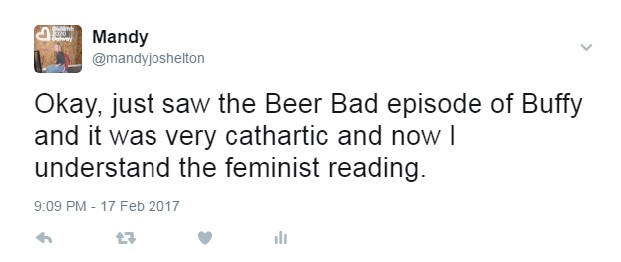



 I’d hit on this Sal Mineo connection during “Tape 5, Side A” (Episode 9) probably about the time Tony helps Clay skip school, so when Wilson Cruz showed up in “Tape 5, Side B,” I almost fell out of my chair.






 Mandy Shelton