Such Good Sports

I have to write this now because I’m on deadline and procrastinating; this movie keeps rattling around in my head, and maybe writing about John Travolta’s magazine assignment will inspire me to finish my own magazine assignment.

I’m not proud of this, but I only finally got around to watching Perfect because of the Jimmy Fallon spoof that randomly showed up on my feed. I don’t watch the late night shows/don’t have a TV, and I confess I googled the wrong Jimmy when looking for this clip again this morning:

Thoughts on Jamie Lee Curtis and this bizarre sexually charged aerobics scene are best left to other people, but I only first learned of this film’s existence a few months ago when it was included in the Alamo pre-show: I’m fairly certain for Love Lies Bleeding and The Substance, but I could be wrong on one of those. Thoughts about those movies, plus the Apple TV show Physical, are part of a bigger project I have in mind, and right now I just need to write about the writing life…as much as that annoys me. Journalism and aerobics? Sign me up and put me in, coach.

The 1985 movie Perfect is streaming on Amazon, and it joins a pantheon of 80s films I think more people would enjoy if they were more readily available on Netflix (I’m thinking of Youngblood here, but also Skate Town USA, which is still eluding me by only being available at Austin Public Library on Blu Ray, and my dinosaur of a laptop can only play DVDs). These movies aren’t really that hard to find, it’s just a matter of convenience. And time.

Here, John Travolta plays Adam Lawrence, a fictionalized version of Aaron Latham, the Rolling Stone journalist who wrote the articles the movie is based on as well as the screenplay for said movie. There’s a lot of meta activity there, with a tangent into Blue Crush and Susan Orlean that will also have to wait for another day, because it gets more meta: Jann Wenner, the founder of Rolling Stone, plays a fictionalized version of himself named Mark. There is so much to unpack there that I’m just going to leave the entire suitcase overstuffed and intact so I can keep rolling on those little suitcase wheels.

While pursuing “real journalism,” Travolta sees two attractive singles interact at a gym; this sparks a story pitch about health clubs as the singles bars of the 80s, which Jann agrees to let him write while he’s in LA to cover legal proceedings for the real story he is pursuing. Dude’s per diem is phat, as is his NYC apartment, and I yearn for the days when writers lived like that. however fantastical (hello, Ms. Bradshaw).

I have so many thoughts about the health club aspect, which I’ll probably save for another post/that bigger project as I get around to it, but since I’m struggling to write my own magazine article today, I want to focus on two things that happen in the course of Travolta’s research: 1) One of the gym trainers tells him he doesn’t want Linda as a source because “she’s the most used piece of equipment in the gym,” and 2) Linda herself tells Travolta that looking for Mr. Goodbody is a lot healthier than looking for Mr. Goodbar, as in it’s better to go to a gym to meet people than to hang out in a bar. Ha ha.

He flat out tells Linda he’s going to use the Goodbody line, which becomes the headline, and the “most used piece of equipment” nickname becomes the concluding hook about the gang bang he witnesses. Yep. Gang bang–Linda’s own words for an entirely consensual experience in a parked van that she apparently invites a Rolling Stone reporter, who has identified himself as such to all involved, to witness. I will also add that, based on context clues and foreshadowing, the [off-screen] gang bang includes the trainer who gave Travolta the “equipment” line by slut-shaming Linda in the first place. Hypocritical? Or just boys being boys? BTW, happy inauguration day to all who celebrate.

Bad writing and bad behavior aside, what I’m hung up on here, today, as I struggle to write my own piece, is how Travolta’s character lets other people’s words write the story for him. The headline and the punchline are both words quoted/borrowed/stolen from other people, and I couldn’t help but wonder… ; )

Where is the line between interviewing and plagiarizing?

Here, in the story that Adam initially writes and had every intention of submitting (and for which someone, probably Aaron Latham, actually wrote the text we and Jamie Lee Curtis can see on Adam’s computer screen), he has gone in with his mind made up about the narrative and just found the evidence and quotes he needed to support that hypoTHESIS in the words and actions of the people he’s covering.

Without getting into spoilers, Jamie Lee Curtis’s character has some experience with this journalistic tendency, and she tells off Adam in a way that I’m still thinking about (and, in the movie, has such a profound effect on him that he perseveres with the other story, the real story he was a covering, in a pigheadedly ethical way that I found deeply satisfying). Her words “It’s not the truth I’m worried about, it’s the tone” keep reverberating as I try to write this admittedly less high-stakes article in a way that honors other people’s words without 1) using their own words against them and 2) allowing their words to drive the story for me.

So here are some more out-of-context screenshots since my Amazon rental already ended. I guess I’ll get to work.

All the Boys Love Mandy Lane

Ok, last one for today–like I said, I am making myself write, but for the life of me, I can’t remember what I had planned for this one.

I finally watched 2006’s Bastrop-filmed, Robert Earl Keen-cameoed All the Boys Love Mandy Lane. There’s all sorts of self-reflection here: it’s Texan, my name is Mandy, but there’s also the topical Amber Heard hatred.

Oh, now I remember: it’s about how easily we slander pretty women, which is tangential to the point of the movie…

This is all coming about because of the Blake Lively smear campaign, which was orchestrated by the same people Johnny Depp hired to takedown Amber Heard. This is such a weird new world of celebrity, all about image tarnishing and reputation management, and I can barely handle my own digital footprint. In a way, it’s cool I could hire someone to do that; in another way, it is absolutely terrifying.

What I keep coming back to is this:

This is two women talking about taking down another woman. I can’t stop thinking about it.

As much as I want to roll my eyes at this, and I very nearly dismissed all of it, I keep coming back to that line texted between two women talking about a third: People really want to hate on women.

The Mandy Lane movie is tedious to watch because of the way it handles Amber Heard’s beauty (and there is absolutely no denying her beauty: remember her at the beginning of Zombieland in 2009? Her 2011 turn as Chenault in The Rum Diary, where she was so stunningly gorgeous Johnny Depp left his French model wife?) This movie was made before all that, when she was a 20-year-old Austin native running around a *ranch in Bastrop allegedly 150 miles from the nearest gas station* as the quintessential–one might say apex–final girl.

In the movie, she resembles a cross between Bella Swann and Betty from the Riverdale series (indeed, Mike from the Twilight movies is one of the better presences in this horror movie). She is constantly pawing at her locks a la Kristen Stewart with her hairpiece, even in some really pivotal life-or-death scenes, and though she’s supposed to be a runner (the final girl has to be in shape enough to run!) her form is gawky at best.

Throughout the movie, the characters’ motivations are so flimsy that the final twists don’t shock because it’s been so hard to tell which character is deceitful and which is just played by a bad actor. The premise, though, is that all the boys are indeed in love with Mandy Lane, and that genuinely motivates every single action they take. It makes zero sense.

It’s hard to talk about Mandy Lane without giving away the end of Mandy Lane, but the idea is that it is supposed to be some sort of commentary about their focus on her, in hindsight. But to get there, you either have to see the twist coming (I did not) or endure this weird behavior the whole movie in order to get to the twist, which honestly does not hold up even when you look back at everyone’s actions through that lens.

I’m going to confess, I thought I knew the twist, and it involved everyone pretending to be so in love with Mandy to be faking it for very detailed conspiracy reasons (maybe that says more about me than the plot, but I’m convinced I read this in a review or spoiler somewhere). That would have made more sense. The people who died had more motivation to kill than the people who actually did the killing. And I think maybe that was the commentary. That beautiful women make us do stupid things.

So back to Blake Lively, and Johnny Depp running off with the co-star young enough to be his daughter, and this book on my nightstand about Helen of Troy, and the women who work as hired guns to take down other women. Yes, it is silly that Blake Lively’s haircare line flopped. In some contexts, it is really funny, as is the fact that Nicepool’s man bun is now part of a case presented in a court of law.

And we are forgetting the context of the movie that started all this. Mandy Lane is a slasher where dumb, good-looking kids (young Luke Grimes is in this one) are meant to get hurt, but It Ends with Us tackled domestic abuse in a way that resonated with a lot of people. I got annoyed because, in the end, the lesson was simply that Blake Lively’s Lily Bloom did not deserve to be abused because she was so beautiful and kind and good. Seriously. That’s what her knight in shimmering armor tells her (accidental Johnny Depp reference I’m rolling with): he says she saved him by looking out her window; he saw her pretty face and decided not to die. Her face saved him, like Helen’s launched a thousand ships. I got the impression, sitting in the theater, that those of us who don’t look like Blake Lively will probably need to fend for ourselves; furthermore, the implication that, if we aren’t perfect little sweet and kind angels, paragons of motherly virtue and patron saints of flowers, maybe we deserve what we get…that stung. It always does. So I almost jumped on the bandwagon when an actress’s public image took a hit, because it was gleeful and fun to do so.

Ultimately, though, I side with the creators, and in this case that means Colleen Hoover. I have never read a single Colleen Hoover book, but I’m not going to deride anyone who reaches that many people. If she wrote the book on men mistreating women and she sides with Blake Lively, flower puns and all, that’s enough to give me pause. It’s the other women’s words, the women destroying another woman for sport (and, yes, pay) that convinced me this is more than just a case of silly celebrities spatting over who gets more attention at the movie premiere.

Wholesome Entertainment

I finally got to watch the Dude Perfect 30 for 30 over Christmas break, so now those guys are on my radar. I keep thinking about the similarities between Dude Perfect, the Savannah Bananas, and The Daytripper on PBS. This is not fully fleshed out, but I’m just trying to make myself write, so here are some half-formed thoughts I’ll revisit later…

They have to do it themselves. That seems to be what unites them all in my mind. One of the talking head journalists in the 30 for 30 doc said something about Dude Perfect taking their own relationship with sports and running with it. I’ll look up the full quote later, but I think that’s the idea behind both Dude Perfect and the Savannah Bananas.

I feel like, if you made a Venn diagram of Savannah Bananas and The Daytripper, you would get Dude Perfect in between. There are probably countless other examples, but these are the three I’m working with. Good clean family fun, wholesome and devoutly Christian, almost entirely populated by white guys. But there’s also something of an entrepreneurial spirit that says “We’ll just create our own game.” I’ve heard The Daytripper tell multiple people in and around Georgetown, those asking how he gets to do what he does, that he just found sponsors. You just have to find a way to finance the thing you want to do.

There is also an element of dads or dads-in-training just wanting to entertain their kids in healthy ways, and making your kids laugh is one of the best skills a man, woman, or non-binary parent can have. This is probably really important to their success, but since I don’t have kids, I’m not going to linger here…

Back to overhearing someone ask The Daytripper how he got to do what he does, plus looking at the Dude Perfect college-guys origin story and remembering how every single dude I knew in college played idiotic games just like that, there is absolutely an element of “anyone could do that.” Anyone could film trick shots and post them on YouTube. Anyone could take a faux-journalistic approach to family vacations. Anyone could reinvent the game of baseball into a sideshow with random rules no one bothers to follow. Anyone could do it. But they didn’t.

I’m thinking of what, for me, was the most poignant scene in A Complete Unknown. Bob Dylan, king-of-the-world-newly-famous Bob Dylan, has just been in a scuffle with alleged “fans” who recognized him on a night out when he thought he was just enjoying the (Irish!) music at a session. He says to Sylvie/Suze, and I’m paraphrasing again here because I can’t research this one right now: They ask me where the songs come from, but what they really mean is, why don’t the songs come to me?

It’s the aspect of envy that, when someone is so expert at something they make it look natural and effortless, we all assume we should be able to do that thing just as easily and just as well. Why aren’t we famous? Why aren’t we getting paid for it? I’m guilty of doing this (in the distant past!) with dance: dancing is something that should come naturally to us, so when we see professional dancers, part of us thinks: I should be able to move like that, no problem. I took dance as a kid. I was on a cheerleading team that performed at pep rallies. I can move. But you can’t, not really, not anymore, not like that.

I would argue every single armchair quarterback has this mentality.

With Bob Dylan, the dude was steeped in music. He lived and breathed music, all kinds–it just happened to be folk that propelled him. He could sit down and write a mumbling, rambling song, full of seemingly off-the-cuff slant rhymes, because he has an encyclopedic knowledge of everything that came before. He found his place within the flow of music that has been co-created right alongside our DNA. (I would argue that this is what the biggest female pop star on the planet is doing now, that she is the Bob Dylan of the social media age, but I don’t want to go down that rabbit hole).

So when I watch the Dude Perfect dudes show off their new headquarters (soon to be complemented by a branded store, just like The Daytripper, full of DP merch, just like the Bananas), I actually don’t get jealous because all I can think is, “Dude, they really love sports.” Like, I can’t imagine loving sports that much. So I don’t feel my ego threatened by any of that, but I can empathize with someone who does.

And bringing it all back home…I’m reading the Dude Perfect book right now, because that’s how I function. I get the appeal; I’m just trying to understand how to make it work for me…without being a jealous dick who punches Bob Dylan in a pub. Suffice to say, this happens a lot with writing and publishing. Lots and lots of people have passion, and sometimes it finds its outlet in punches or posted comments. Sometimes, when we listen to our higher angels and some really savvy money guys and social media mavens, we can find a way to make it work for us, to make it pay.

Like I said, I’m still working through this one… 😉

Dude! AI generated this image based on my content! I am not entirely sure what sport they are playing, but that’s kind of the point!

In Defense of Merle Kittridge

I just rewatched Bell, Book and Candle because I’m back on my witch shit, but also it’s a Christmas movie after all, and this viewing had the brunette fiancee stereotype nailed. There’s been a trend in recent years to flip the tropes of Hallmark movies and unimaginative rom-coms: watch the movie in reverse, and the woman escapes her small town to become a high-powered big-city career girl; if you are brunette and focused on your career, you will absolutely lose your boyfriend/fiancee/husband(?) to the blonde protagonist; be careful not to visit your small hometown over Christmas, or the Christmas tree farmer who never left town will trap you with his rugged good looks and folksy wisdom. Stuff like that.

So I’ve been paying extra mind to the non-other women in these movies, the ones whose perspective makes the protagonist’s behavior look selfish at the least, insane at the most. Carrie Bradshaw is our favorite anti-hero in this regard; the woman cannot stop fucking up. There’s a long, luxurious deep dive I want to do into the psyche of Big’s first wife, Barbara–a children’s publisher whose deceased ex-husband left his second wife a million dollars, his third wife with a lifetime’s worth of “I couldn’t help but wonder…” questions. What did he leave her? How has her career progressed? What was their marriage like? I have so many thoughts, fan fiction levels of ideas, and I do think she is the most interesting side character in the entire Sex and the City universe.

But, as usual, I got distracted talking about Sex and the City. Another perfect avatar of the brunette career-girl fiancee is Parker Posey in You’ve Got Mail, a movie I don’t care to rewatch (I am growing weary of the “we must save this beloved neighborhood bookstore none of us actually spend money in” attitude, but that’s a separate post as well). It doesn’t matter if I do the research because it’s Parker Posey, which is enough, but her character Patricia Eden works in publishing too. Perfect. No notes, mostly because I don’t want to rewatch the movie.

So, back to Merle. We learn of her through letters on Jimmy Stewart’s desk, which Queenie has leafed through, but when we first meet her, she is wearing this exquisite green dress I would argue rivals Kiera Knightley’s Atonement green dress, adjusting for inflation and, you know, 1958 morality standards.

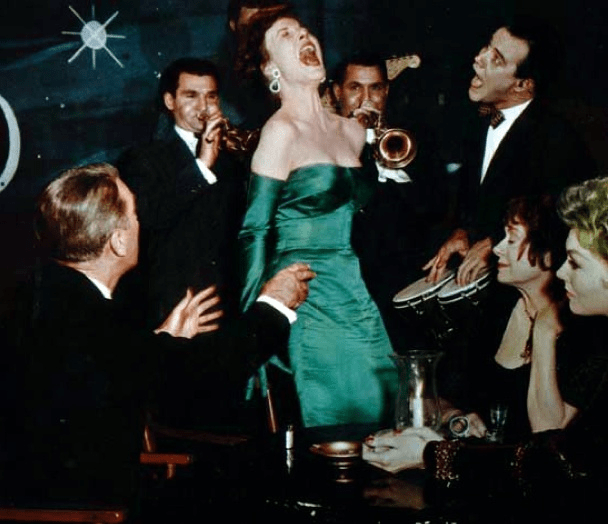
Anyway, before I get too carried away looking at images of green dresses on Pinterest, the point is that Merle herself is actually an interesting character. She went to college with Gillian and was known as something of a “beau-snatcher”; she once wrote an anonymous letter to the dean complaining about a girl attending class barefoot. She is deathly afraid of thunderstorms. She agreed to accompany her fiancee to the Zodiac club, where the musicians torment her until she leaves (granted, she had just insulted one of them, the perfectly gay-coded and bitchy Jack Lemmon). I’m not sure what she does for a living, but she has a nice apartment to herself, though Jimmy Stewart rightly asserts that she needs to redecorate, and she paints in a skilled abstract style that is too confusing for him. After he jilts her on Christmas Day, she refuses to take him back. Yeah, she is kind of unpleasant, but she has a rich inner life. She was simply with the wrong man, and it took a bit of witchcraft to convince them both of that.