References Available Upon Request

I no longer provide references on generic job applications. Even if the application is a form I have to fill out that specifically asks for one to three professional references, I simply write “Available Upon Request” in every blank until it lets me move on. Is it costing me job opportunities? Maybe. But my new “references available upon request” policy saves me heartache and humiliation, and credit must go to a local business.

I have been looking for a part-time job since I left the brewery taproom at the end of 2018. I need something to supplement the teaching and writing that pays steadily but doesn’t keep me out all hours of the night. Beertending was great money and a lot of fun, but it had slowly begun to take over the parts of my life that matter more. I needed to carve out more time for books and reading, so I started looking at returning to a bookstore environment. I have a fair amount of experience and have even written a master’s thesis that explores the industry. I am, in a word, qualified, yet have not been able to get a job in this particular field–stateside–since 2006.

It is possible that I am overqualified. The local chain store has rejected my application multiple times over the past ten years, the famous one in the closest big city has been doing it for even longer, and two new! local! independent! bookstores have rejected me more recently. In fact, this summer, after a five-page application (not including the personal essay I wrote for the “Get creative!” attachment), an hour-long interview that had to be rescheduled when the interviewees could not get organized (that should have been a red flag), and a solid month of wondering, I got rejected from yet another bookstore. (The other did not even acknowledge my application).

This is nothing new, but what makes me extremely angry is that they called at least two of my references. I know, for a fact, that these two references gave me positive referrals during what have been reported as quite lengthy conversations that took place before I had even been asked to come in for an interview. Yet I got to be the one to explain, when these references naturally inquired, that I did not get the job. I have been a hiring manager and never wasted someone’s time with references until I was ready to hire someone. Now, I am making sure that it never again happens in my name.

Most of us have learned that dream jobs do not arrive in the form of fillable PDFs. I finally read Designing Your Life during this summer of self-improvement, after hearing about it for years and unexpectedly meeting the authors at a conference last October. Bill Burnett and Dave Evans write: “Most great jobs–those that fall into the dream job category–are never publicly listed…Using the Internet as your only job-finding method is nothing short of masochistic.” Accurate.

Five-Paragraph Essays

Inspired by an article I read in Publishers Weekly, I am trying to start a new practice where I blog a daily five-paragraph essay. I have a backlog of story ideas floating around and have felt this niggling lack of accountability over the past month or so, despite journaling religiously. Plus, this exploration gives both my semester syllabus planning and work-in-progress campus novel plotting a bit of room to breathe. A five-paragraph-a-day habit, if it sticks, should hone my work ethic and help me become a better writer and teacher.

Rion Amilcar Scott caught my eye when the PW email newsletter opened with his syllabus-as-story-structure piece. I’m toying around with something similar, in both my campus novel and my course planning for fall, so I made sure to read the whole article when I had a moment this morning. I laughed out loud at the line, “One never sees a five-paragraph essay in the wild,” and easily followed his reasoning for using the confines of the five-paragraph structure as a springboard for what turned out to be a novella.

As a professor of Comp 101, Scott draws on a book by John Warner titled Why They Can’t Write: Killing the Five-Paragraph Essay and Other Necessities to call into question the ubiquitous essay format. I allow the five-paragraph essay in my class, though it is not required, primarily because five paragraphs of one hundred words each make for an easy essay to both write and grade. Other professors demand it, while still others sneer at its very existence. An academic auteur playing with this in the world of fiction, however, tickled my professorial ennui in a way that “I Would Rather Do Anything Else Than Write the Syllabus for Your Class” failed to (even though that’s exactly where I am in life and in the school year).

As a fiction writer, Scott’s examination of the essay became even more compelling as he detailed the decision to adopt and eventually abandon that rigidity as a narrative device. He attempted to write his story as a series of five-paragraph essays that tracked the student’s development as a writer over the course of a semester. The exercise did serve to help him get inside the head of his student character, and I hope a similar attempt on my part will allow for more compassion in the classroom (one student has now emailed me six times before the start of the semester).

Ultimately, Scott broke free of the serial five-paragraph structure, though his story appears to build toward one final essay (I have not yet read his collection, The World Doesn’t Require You). Scott’s argument that the five-paragraph essay positions itself “opposite of mature, fully realized work,” underscores the fraught relationship we set up with our students, especially those required to take English Comp (often more is demanded of them than of the students who are exempt). If our own writing is free flowing and intuitive, teaching a stagnant structure, however reliable, can ring false.

Layoff

“Getting laid off just seems like a good excuse to do something different.”
–Kat, The Bold Type

I’m knee-deep in the layoff episode of The Bold Type right now, reflecting back to the “layoff” scene from The Handmaid’s Tale.

My layoff is over. The department is completely closed. The one girl they left behind to help with the transition has found a new job, so it’s over.

Jane copes with the layoff by getting cold-called for a dream job. Poor Jane. This is why I can’t relate to her. There is nothing but praise for her writing, though the show provides very little justification. “Of course, you’d have your own column.” Of course.

Work Hard and Be Nice to People

[*This is a draft from a year ago.]

Networking is yuppiespeak for “talking to people.” Some people do it well, some people do it poorly, and some don’t do at all. One of the reasons I have risen in the ranks of the Local Yuppie organization is my ability to talk to people–because sometimes it seems like I’m the only one willing to do that.

I’m not even that good at it. I was an extremely shy kid, but Ireland cast a spell on me and now I have the ability to hold a conversation with anyone. Yes, I have kissed the Blarney Stone, which sure and begorrah has given me the gift of gab, but the true credit belongs to the Irish pub, where I learned how to talk to anybody and everybody.

One of my biggest complaints about the Local Yuppie organization is that they can be a little cliquey. I remember when I first started coming to events, before I had actually joined, how difficult it was to even identify the members of the board, let alone get them to talk to me. Some of them were outright hostile. I actually enjoy getting under people’s skin, so rather than scare me off, that actually motivated me to get more involved. There were a few events where I showed up just to see how badly I could piss off the ones that clearly didn’t like me.

All this, and now they want me to be president. Not because I’m the best person for the job, but because they didn’t build a sustainable organization and now no one wants to run it. I’ve heard other young people in the community complain about feeling unwelcome in the organization, and I know it’s true because they did the same thing to me at first. For people who are less contrarian than me,  that’s a total turnoff. The organization doesn’t grow because most people don’t choose to hang out with assholes in their free time. We get enough of that at work.

Failure

[*I wrote this post in January and just now found it in my drafts.]

My New Year’s Resolution (besides quitting smoking) was to fail spectacularly at something every week. The idea was to inoculate myself against a fear of failure while simultaneously forcing myself out of my comfort zone.

The fact that I struggled to remember what the Week One failure had been was in itself a lesson in letting go. But I went through emails, texts, and calendars until my browser history jogged my memory.

Week One:

Tweeted at Jenny Bicks, Sex and the City writer, and panicked/rejoiced so much when she responded that I didn’t read her tweet closely and answered the wrong question.

Week Two:

Got rejected for a job (didn’t even land an interview) by a nonprofit the same day I had tickets to attend one of their fundraisers, so I got to see the person who wrote the rejection email and the person I would have been assisting basking in their smug, cool job glory.

Week Three:

Got bamboozled into buying new tires for my car after having a blowout. Was so puffed up on the fact that I’d changed the tire by myself that I neglected to practice smart consumerism and marched in there ready to spend $800.

Complicated in an uninteresting way

Confession: I am really bad at pitching stories. Always have been. It’s what holds me back as a writer. I could easily tackle my issues with commas and hyphens if I had anything important enough to say, but the narrative drive isn’t there. I’d love to write a book but have no idea what to write about, and my journalism career stalls out when I can’t bring anything to the table.

I once interned at Texas Monthly, and one of the perks is that interns get to attend the pitch meetings. Interns can pitch story ideas as well, and it’s kind of a big deal to have one picked, so when Evan Smith came looking for me to shake my head, I was extremely giddy and had to call my mom. Even so, it was just the generic “I love Veronica Mars and Rob Thomas is from Texas so someone please interview him” story on my pitch sheet, not the other four painstakingly detailed proposals I had carefully crafted. I was not the only one to have suggested a Rob Thomas story, and it eventually became a reality around the same time the Veronica Mars movie did.

For a former journalist, I often wildly miss the point. The last few magazine stories I’ve pitched have fallen flat, except for the one that was picked up by another writer AFTER I had severed my relationship with that publication and totally may have just been the editor thumbing her nose at me.

One of my college professors once wrote a comment on my personal essay: complicated in an uninteresting way. That is me to a T. I tend to overthink things that don’t matter to anyone but me. The thing is, they matter deeply to me. They’re pretty much all I care about, what I spend my time thinking about, and what I write about when I have the choice. No one reads my stuff, but who cares? I’m staying true to myself, right? In the eloquent words of our president: Sad!

Like everyone else in the free world, I’m listening to S-Town right now, and in some way, the meandering story gives me hope. Like, if you stick with something long enough and have enough talent, you’ll someday give it shape and meaning and purpose and people will go nuts over it. But that’s only if you identify with the narrator of S-Town, the podcaster who crafted this story from a huge cast of characters and a range of disparate events that happened over several years, pulling it all into a cohesive seven episodes in a nice studio with some of the most talented people in the business and, oh yeah, a salary.

Sometimes, I identify most with John B., building shrub mazes in my backyard, ruminating over the world’s problems, and never getting anywhere.

Imagination should be used not to escape reality but to create it.
-Free Will Astrology


Hold up, am I the mom?

Dig, if you will, this picture…of me and my cheese plate engaged in some bliss:

cheeseplate

The photo was taken six months ago in a wine bar during a social gathering for the Local Yuppies, the creative class / talent development organization of which I was then vice president. There were about 30 people in attendance, but only two board members, and the absence of the president made me the ranking officer. Since I was under pressure to take over as president for the 2016-17 fiscal year, it was a chance to see how I would run the organization.

I had gotten to the wine bar early, ostensibly to make sure everything ran smoothly, but mostly because I was excited about my new daily planner and wanted some alone time: just me, my planner, a glass of wine, and, most importantly, some food. I was starving.

Alas, at least three other people decided to be early, so I had to start performing my duties the moment I got there. I ordered my wine and food as quickly as I could, then set about networking, a word of yuppie origin that loosely translates as “talking to people.”

I eventually found a tall chair and sat with a new attendee while sipping Pinot Grigio. My cheese plate arrived and it was huge. For $10, I got a smorgasbord. The woman delivering it to my table asked if I want honey or hummus. “Can I have both?” I asked, and she said of course. This in addition to the cheeses, bread slices, crackers, fruits, chocolate deserts, and scone. A scone. The cheese plate included an entire fucking scone.

At the same time I was managing my hunger, I was also managing Local Yuppie business, greeting people and posing for photos. I scolded a few book club members for not showing up to that contentious May meeting. At one point, I had to go to the front of the room, leaving my table companion with the suggestion to eat whatever she liked off my plate.

In my travels to the front of the bar, a distance of about 20 feet with about that many people in the vicinity, two separate individuals stopped me to ask me about the cheese plate. See, our social venues usually (but not always) provide free appetizers to pair with the drinks we are buying. However, since this social had been planned at the last minute, there would be no free nibbles that night. Upon seeing the giant plate of food at the table of the acting president, it was perfectly reasonable for some members to assume it was a shared plate.

So I shared. I told people it was my food, but there was plenty of it and they were welcome to pick off the plate. Over the course of the evening, I watched my apple slices, an entire cluster of grapes, three out of four bread slices, and one of my chocolate desserts disappear from my plate. One girl sat down in front of me and ate that entire fucking scone while telling me how awesome she was and how she would run things if she were in charge. I finally interrupted her to crumble off a corner of the scone, just so I could find out how it tasted.

It was around this time, watching my food go travelling off my plate whilst dispensing career advice and volunteer opportunities, that I had this exact epiphany:

Yes, apparently I am the mom. And my kids were hungry. So I fed them.

All this time, I’ve been wondering what the organization could do for me. In two years, I have hired only one writer through the LY network, the original reason I joined the organization. I don’t see it advancing my own career either, partly because publishing isn’t really a growth industry around here, and partly because I’m 30-something and more advanced in my career than most if not all of the LYs. Some of them are barely out of college. But it does raise questions about mentorship and paying it forward and how I can truly develop some leadership skills, instead of shrugging off the chance to take charge because I don’t like responsibility. We’re all adults here, yes, but some of us are more grown than others: when the waitress took my empty plate away, I noticed not a single person other than me had ordered food.

With service to any organization, the rewards aren’t always immediate or even visible. It’s November now, the new fiscal year, and I did wind up being president of the Local Yuppies. I’ve avoided the word “leadership” since high school, so it’s odd learning to steer a ship again. Today, I went to lunch with one of our new board members to make plans for the holiday charity season. She said she didn’t often get asked to lunch and appreciated the invitation.

Then she paid for my food.


Content with Content

[*This is a draft from a year ago. I redacted the details.]

I’m writing my first article in three years, and I’m struggling to get where I want to be. I have the basic angle the editor asked for, my own interest in the topic, and a buttload of quotes from relevant people. However, the article is not quite doing what I want it to do. I want it to be funny and fresh, not boring and overdone. I’m not covering breaking news, and I need to be able to impose my own worldview on this piece.

And lately I’ve been panicking that I have no worldview, that I don’t know where I stand on [redacted] and therefore I must be a cardboard cutout of a human being. Especially since we’re looking at starting our own chapter, I wonder what we could be doing differently, or if I’m just trying to reinvent the wheel. We had [redacted], and not enough people signed up. We don’t need to be doing more stuff; we need to do the stuff we’re doing better.

And then I’m looking at how I need to be a content writer, not just a writer, how I need to package myself and my writing. And this is all really interesting to me but now that I have a chance to put it into action I’m balking. Because I ALWAYS have this problem and I’m a terrible human being and I will never succeed at anything. This is exhausting, and it’s getting a little old.

So let’s try something new and believe in ourself/ves? Believe in elves.

The first thing I need is a title. It will probably be changed, but it’s basic that I should craft one anyway. Maybe I need an outline as well.

  1. Children
  2. [redacted]
  3. Nonprofit Organization

You’re stalling. Scared to make a call. Looking for permission, or call it research if you must.

What do people need to know?

I wrote some more last night, reading the research by the pool. I’ll put that into my document after I’ve retrieved it from the car, but I don’t think this is very good. I’m not happy with it.

What I want to say is that [redacted] are people who don’t actually use the [redacted], just want to support its continued existence. But I have to say that in a way that 1) considers that some of them will insist they actually do use the [redacted] and 2) doesn’t raise class division issues and 3) is funny.

You’re balancing:

  1. What your editor wants.
  2. What the reader wants.
  3. What you want to write.
  4. The information you have.
  5. What the subject would like to see written.
  6. What is good for the world.

People nowadays prefer listicles.


What happens to a dream unheard?

Harlem (1951)
by Langston Hughes

What happens to a dream deferred?

Does it dry up
like a raisin in the sun?
Or fester like a sore–
And then run?
Does it stink like rotten meat?
Or crust and sugar over–
like a syrupy sweet?

Maybe it just sags
like a heavy load.

Or does it explode?

Lately it seems everyone I know wants to be an entrepreneur. I don’t know if it’s my age or my geographical location, but everyone is talking about their business plans.

But I have yet to see an actual business plan.

One girl told me yesterday that she wants to start a nonprofit, buy an existing business, and take on a part-time job (this is in addition to her full-time job), all while finishing grad school. Oh, and she and her husband want to start a family. He, too, is either about to change jobs or start his own business, they aren’t sure which.

I’m not saying it can’t be done… I’m just wondering how much of it is bullshit.

More than likely, most people are just voicing their unfiltered dreams. Everyone has an idea for a business that would fill a need, or a charity that would cure a cause célèbre. I am currently Founder/CEO of three separate imaginary businesses, and just picked a location for a fourth. That location is in my head, which is where most of these ideas should probably stay.

I do understand the appeal of talking things through with people, and I am well aware that collaboration is a sort of human sorcery that creates ideas stronger than the sum of their parts. And I don’t mind having discussions about a friend’s ambitions, provided my input is actually welcomed and he is not just using me as an echo chamber. These businesses are rarely presented as ideas, though. They’re presented as sort of self-validation, like the person is using these imaginary enterprises to establish their own personal brand, without having done any of the actual work.

I once listened to someone spend three years telling everyone she knew that she was starting a nonprofit. I was in a nonprofit training course at the time and tried to be of assistance. She eventually gave up on those plans when she learned that nonprofits… do… not… make… profits. Nonprofit: it does exactly what it says on the tin. She hadn’t realized she would be assigned a salary. “I want to make bank,” she told me, and we never heard about the nonprofit again. I swear this actually happened. I’m not making it up.

What I always fear is, if you do this often enough, you unintentionally market yourself in a negative fashion. You’re more likely to be seen as a person who never follows through on anything. Ideas are easy, guys. They are. What’s rare is the grit and gumption to see ideas through to fruition, and that’s really all that matters.

Another friend told me, just this morning, “I only like the start of things. I should be a venture capitalist.” And I see the temptation, I really do. I would much rather be an “idea man” or a “big picture person.” But I wind up doing a lot of legwork for idea (wo)men, and usually all it does is make me lose respect for them. I get the value of learning how to actually run things, and more often than not, the people who matter–the higher-ups, the team members, the end user–are perfectly capable of seeing who is really taking care of business.

If you’re an idea man who doesn’t have the luxury of letting someone else do the legwork for you, your dream will never even leave your head. How painful that must be, for you and everyone around you. I’m reading A Raisin in the Sun for work right now, and just happened to see on my calendar that yesterday was Lorraine Hansberry’s birthday. I saw a production of the play in London about 15 years ago, but I’ve never actually read it, and there’s this interesting side note about “the rat scene” that doesn’t exist in the original text. I found the 1961 Sidney Poitier movie last night as well, but I’ll wait until I finish reading.

I used to identify with Beneatha, but I’m a little older now (and weary) so Ruth is the one that gets my sympathy. She’s married to one of these people, the ones with the dreams deferred:

RUTH (Wearily). Honey, you never say nothing new. I listen to you every day, every night and every morning, and you never say nothing new. (Shrugging) So you would rather be Mr. Arnold than be his chauffeur. So–I would rather be living in Buckingham Palace.

Campus Life

One of the perks of working on a college campus is that you never really have to let go of that well-rounded, renaissance man-dy, interdisciplinary ethos. You still get to do a little bit of everything:

20160429_120401

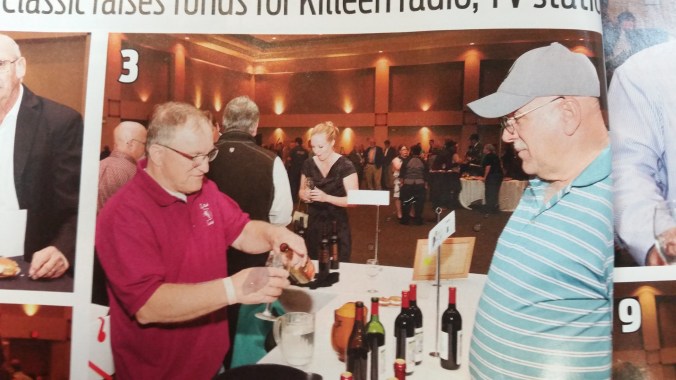
Here I am at the wine tasting fundraiser for the campus-hosted public radio and television stations. The event actually happened April 1 (my workiversary) but the photo was just published in the local society magazine. I am not named in the caption, by the way.

FullSizeRender

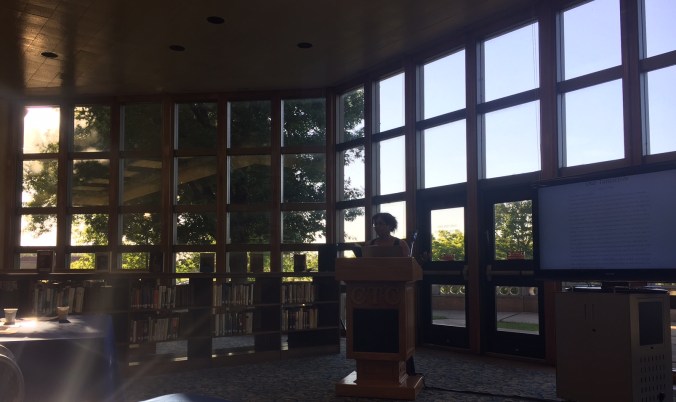
This is the launch of the campus literary journal, which took place on Wednesday evening in our library. Isn’t it gorgeous? We have the best view from a library I’ve ever seen in person.

IMG_0931

Here I am, dying, during the 5k around campus this morning. I love the Golden Arches in the background.