And You’ve Got to Keep Your Own Orbit Going

And you've got to keep your own orbit going.

I’ve been working my way through White Lotus before the new season drops, and I’ve been dragging my feet on starting season two because I know I’ll binge the whole thing but, also, I wasn’t all that wild about season one. It was more about catching up on what everybody was talking about, though I absolutely love the premise: let’s create an anthology series that moves around luxury resorts in stunning locales as an excuse to talk about class issues. Kai’s story was just so gut-wrenching, and not necessarily in an edifying way, but my favorite storyline was the absolute dork of a teenage boy (the crazy emperor twin from GladIIator) slowly falling in love with the ocean, as unrealistic as that resolution was (as was the quick and sloppy law and order that surrounds every crime that takes place, but I guess if you want a justice procedural, you know exactly where to find one that’s been on the air for two decades and launched countless spinoffs).

This overlaps with some personal heartbreak of mine, and this is my attempt to feel my feelings. I saw something during a doomscroll that said you ruminate when you are not letting yourself feel something–you’re trying to intellectualize pain, or sadness, or heartache, or rage, or whatever. So the rumination on this particular White Lotus storyline is partly because it’s a fictional depiction–one of the few I’ve ever seen on this topic–that perfectly illustrates something I thought only I felt.

As an aside, I have to add that one of the people who told me about this show was the resident floozy (her words) on the one and only foreign yoga retreat I have ever attended. She and I happened to be on the same flight out of Houston, a fact we discovered in the pre-trip WhatsApp group. She was late to the airport, but we sat together–I held her a seat while she held up the plane, and I should’ve known then, but I was in my namaste open-to-the-universe phase of healing…a time ripe for picking by hustlers and manipulators. I can see why women my age GOING THROUGH IT get sucked into cults. Anyway, she talked about White Lotus on the plane, since we were heading to a tropical resort, but I had no idea that I was sitting next to our very own Jennifer Coolidge. The Tanya McQuoid of that week in paradise was twenty years younger and without the family money, but she was every bit as lacking in self-awareness and wrongly convinced of her own business acumen. (Again, I have only seen Season One, but I know what happens at the end of Season Two because the internet cannot keep a secret for long–including me. I’m about to lightly spoil Season One if you haven’t seen it.)
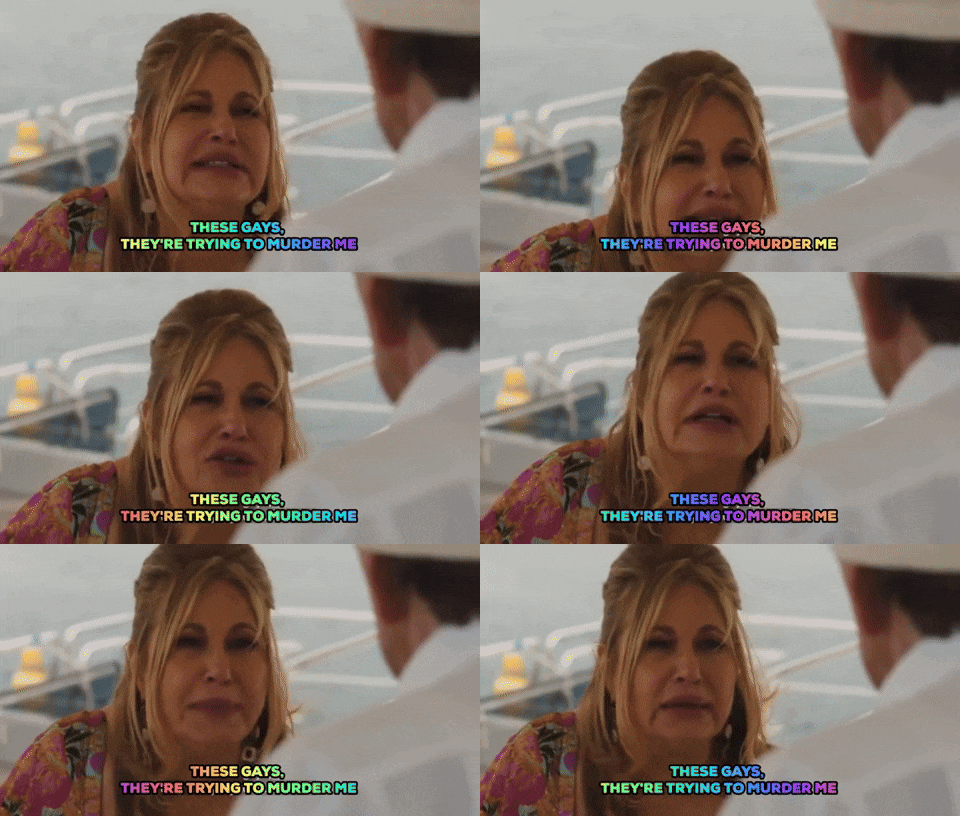
Anyway, there’s a very long rambling tangent (one might say rumination?) on my introduction to White Lotus. Without any further ado, here’s the character that scared the shit out of me in Season One.

We need the impact for the crazy eyes.

Rachel’s backstory is that she has married a man who covets her but does not understand her. He may love her, as much as he is capable of love, but she knows she is trading what she wants (a career in journalism) in a “Faustian bargain” for money and security. Needless to say, this happens a lot. So often, in fact, that I would argue we’ve grown numb to this storyline, so I think what caught me off guard about Rachel is the fresh take the show brings to that fear, and I do wonder, without googling, how much of Mike White’s own professional career has fed into Rachel’s story.

There are two-to-three major knots in this story thread that I want to tease out. First, Rachel has in the past written a profile on another guest at the White Lotus (Mrs. Coach T, playing a type of Sheryl Sandberg character here). Rachel has somehow profiled the woman without ever meeting let alone interviewing her. She admits, twice, that she basically repurposed something that ran in another publication, which Mrs. Coach T. rightly calls “just bad journalism.” I know I’m not currently earning a living in New York media, but I’m not sure that a Business Week-esque magazine would run a refurbished profile based on someone else’s reporting, but I could be very naive here. Rachel does say she writes a lot of clickbait, so it’s possible it was an online-only piece. Regardless, the magazine has enough legitimacy for Mrs. Coach T. to have read the profile…which she hated.

[Insert screenshot of Mrs. Coach T. saying “That was…a…hatchet job” with such aplomb I’m still hearing it.]

This ties in with the other knots in this thread, because that’s how knots work. Rachel has been offered another profile that honestly sounds like a lot of fun (van orgy at Burning Man) but her husband doesn’t want her working on their honeymoon. He, meanwhile, has spent their honeymoon “throwing the world’s biggest tantrum” and “tormenting that poor man” (Rachel’s words), capped off with a visit from his mother, so basically he’s been doing the rich person version of “work” the entire time. But when she wants to accept an assignment, to keep the network connected and wheels greased on her career, he says no. It is under this premise that she approaches Mrs. Coach T, to get advice, one career girl to another. She then gets eviscerated as only a writer can: It wasn’t your story to tell (twice removed) and, furthermore, you butchered it.

Pausing here to think of times in my career when that has happened, and often (but not always) it was the heavy hand of a bad editor. I cannot stress enough the importance of a good editor. Maybe this is what Rachel is alluding to when she talks about her industry connections, because there is no mention of a bad editor when Mrs. Coach T quotes “She rode the Me Too wave,” the line she take offense to in Rachel’s piece because it implies she stood on the empty and broken husks of other women’s careers to reach the pinnacle of hers.

“Because, for him, I’m hysterical about the fact that I can’t make 200 dollars writing hack-job articles that are clickbait. But, for me, that’s my entire career and that’s my entire life.” Alexandra Daddario explains character motivations in this behind-the-scenes footage.

All that leads to this third knot, the scene that shook me: Rachel trying to explain to her husband that she is afraid she doesn’t have any talent. He’s not listening to her, which is telling, because the words coming out her mouth are some of the scariest words a person can say. I don’t know if it’s just women, or if it’s the circumstances surrounding Rachel’s doubt, but this slippery slope right here is where many, many people crash and burn. It’s a steep fucking slope, and the slickness is not the fun kind. It’s black-ice terrifying. And having a partner who fails to recognize that can rip the soul right out of you before you even realize you’re in danger.

Yeah, I’m mixing metaphors here. I’m ruminating over Rachel’s storyline because I’ve rarely seen that kind of vulnerability about the creative life expressed on screen. Mostly because no one gives a shit–I’m deflecting here, but I genuinely don’t think anyone cares about this part of Rachel’s storyline, not when there was so much else going on at the White Lotus. It’s that moment, when Mrs. Coach T asks “Did you sign a pre-nup?” that sets it up, and Mrs. Coach T knows what that means: he says he’ll take care of you, but if you get off this treadmill, you will never gain this momentum again.

Be damn sure before you get off the Ferris wheel,
because the women waiting to get on are 22, perky and ruthless.

So Rachel’s story, and this is so obnoxious that Belinda literally gets up and walks away (a separate “Magical Negro” issue that I have no business commenting on here, but for the Louise from St. Louis of it: someone argued the other day that Louise is a figment of Carrie’s imagination brought on by the trauma of being left at the altar, and I can’t get over that–none of Carrie’s friends ever interact with her!) Anyway, Rachel’s “problems” look like rich people problems because they’re invisible: you can’t get assignments without the clips, and you can’t get clips without the assignments, so you have to be reliable and available. This is a boundary-setting issue I am only just now figuring out, but there’s a reason publishing is populated by rich kids…no one else has the safety net required to navigate this industry.

But the fear that you aren’t talented enough to see it through–I’m trying to hold space for this one, and the lack of a supportive partner, not necessarily because he’s mean, but because he just doesn’t get it–it’s so isolating and lonely. I’m scared to write about this because it sounds like I’m writing about one man in particular, the Shane/Pete character on his honeymoon at the White Lotus, but I’m not. I have come to realize that this is a theme in my life, a consistent problem in my romantic partnerships, and this White Lotus storyline hit so hard because I never talk about it. But I once had a conversation with a situationship where I had to say (text) the words: “I don’t think you can support my creative life.”

I didn’t even have the courage to say it in person; I had to send a text. Because it was my truth, and it was real, but I have never been brave enough to fight for that part of my life. Even afterward, I didn’t feel strong or brave or empowered; I felt so stupid saying those words that I still haven’t gotten over the cringe. The only thing I can cling to, the only rationalization I can muster, is that I had to go through that awkward moment so it would be easier next time. So I never compromise on that slippery slope again.

In the most haunting aspect of Rachel’s story, she finally gets up the nerve to admit she’s made a mistake. It’s incredibly brave, and hard, and scary, and so complicated that it leads to the big death of season one. When it’s all said and done, we see her husband waiting at the airport. This is where we met him in the flashforward at the beginning of the season, when a couple asked “If you’re on your honeymoon, where is your wife?” He tells them to fuck off, politely, before staring out the window at the makeshift casket of human remains being loaded on to the plane [my law-and-order question here is, if Thailand was next on their honeymoon, which plane is this and should the body and killer be heading to the same destination, but that is a separate tangent]. We’re meant to suspect, at the beginning of the story, that the unseen wife of the honeymooning couple might be the body being loaded onto the plane, but Rachel’s fate is actually…dum dum dum…much worse.

Because she goes back to him. At the last moment, she arrives at the airport, and the relief on his face contrasts horribly with the apprehension on hers. I understand there’s an element of “til death do us part” here, and Shane/Pete has absolutely been through something perhaps life-changing (probably not, he’s obnoxious and rich), but we fucking know Rachel is lying when she claims: “I’m happy; I’ll be happy.”

So she made her choice, to ski down that slippery slope in the best ski gear money can buy. To give up on her career, which probably wasn’t going anywhere anyway, because Mrs. Coach T said she had no talent, which was probably true, but I guess we’ll never know because she gave up.

Oh! I just remembered another work of fiction where I have seen this done well! The original series finale of Party Down (ergo, spoiler). Lizzy Caplan finds out her one line, her big break, has been cut from the Apatow movie, and she is understandably distraught. Adam Scott (who has abandoned his own once-promising and passion-driven acting career) tries to comfort her in a ham-fisted way, and she tells him: “I know what you’re trying to do; I know that you’re trying to help me. Maybe if we were the same kind of crazy, but we’re not. Because if you’re not crazy enough to believe it for you, how are you going to believe it for me?”

'Cause if you're not crazy enough to believe it for you,
how are you gonna believe it for me?

And just like that…I found some compassion for the other half of this dynamic. Because their doubt in you–even if they love you–is rooted in doubt in themselves.

Such Good Sports

I have to write this now because I’m on deadline and procrastinating; this movie keeps rattling around in my head, and maybe writing about John Travolta’s magazine assignment will inspire me to finish my own magazine assignment.

I’m not proud of this, but I only finally got around to watching Perfect because of the Jimmy Fallon spoof that randomly showed up on my feed. I don’t watch the late night shows/don’t have a TV, and I confess I googled the wrong Jimmy when looking for this clip again this morning:

Thoughts on Jamie Lee Curtis and this bizarre sexually charged aerobics scene are best left to other people, but I only first learned of this film’s existence a few months ago when it was included in the Alamo pre-show: I’m fairly certain for Love Lies Bleeding and The Substance, but I could be wrong on one of those. Thoughts about those movies, plus the Apple TV show Physical, are part of a bigger project I have in mind, and right now I just need to write about the writing life…as much as that annoys me. Journalism and aerobics? Sign me up and put me in, coach.

The 1985 movie Perfect is streaming on Amazon, and it joins a pantheon of 80s films I think more people would enjoy if they were more readily available on Netflix (I’m thinking of Youngblood here, but also Skate Town USA, which is still eluding me by only being available at Austin Public Library on Blu Ray, and my dinosaur of a laptop can only play DVDs). These movies aren’t really that hard to find, it’s just a matter of convenience. And time.

Here, John Travolta plays Adam Lawrence, a fictionalized version of Aaron Latham, the Rolling Stone journalist who wrote the articles the movie is based on as well as the screenplay for said movie. There’s a lot of meta activity there, with a tangent into Blue Crush and Susan Orlean that will also have to wait for another day, because it gets more meta: Jann Wenner, the founder of Rolling Stone, plays a fictionalized version of himself named Mark. There is so much to unpack there that I’m just going to leave the entire suitcase overstuffed and intact so I can keep rolling on those little suitcase wheels.

While pursuing “real journalism,” Travolta sees two attractive singles interact at a gym; this sparks a story pitch about health clubs as the singles bars of the 80s, which Jann agrees to let him write while he’s in LA to cover legal proceedings for the real story he is pursuing. Dude’s per diem is phat, as is his NYC apartment, and I yearn for the days when writers lived like that. however fantastical (hello, Ms. Bradshaw).

I have so many thoughts about the health club aspect, which I’ll probably save for another post/that bigger project as I get around to it, but since I’m struggling to write my own magazine article today, I want to focus on two things that happen in the course of Travolta’s research: 1) One of the gym trainers tells him he doesn’t want Linda as a source because “she’s the most used piece of equipment in the gym,” and 2) Linda herself tells Travolta that looking for Mr. Goodbody is a lot healthier than looking for Mr. Goodbar, as in it’s better to go to a gym to meet people than to hang out in a bar. Ha ha.

He flat out tells Linda he’s going to use the Goodbody line, which becomes the headline, and the “most used piece of equipment” nickname becomes the concluding hook about the gang bang he witnesses. Yep. Gang bang–Linda’s own words for an entirely consensual experience in a parked van that she apparently invites a Rolling Stone reporter, who has identified himself as such to all involved, to witness. I will also add that, based on context clues and foreshadowing, the [off-screen] gang bang includes the trainer who gave Travolta the “equipment” line by slut-shaming Linda in the first place. Hypocritical? Or just boys being boys? BTW, happy inauguration day to all who celebrate.

Bad writing and bad behavior aside, what I’m hung up on here, today, as I struggle to write my own piece, is how Travolta’s character lets other people’s words write the story for him. The headline and the punchline are both words quoted/borrowed/stolen from other people, and I couldn’t help but wonder… ; )

Where is the line between interviewing and plagiarizing?

Here, in the story that Adam initially writes and had every intention of submitting (and for which someone, probably Aaron Latham, actually wrote the text we and Jamie Lee Curtis can see on Adam’s computer screen), he has gone in with his mind made up about the narrative and just found the evidence and quotes he needed to support that hypoTHESIS in the words and actions of the people he’s covering.

Without getting into spoilers, Jamie Lee Curtis’s character has some experience with this journalistic tendency, and she tells off Adam in a way that I’m still thinking about (and, in the movie, has such a profound effect on him that he perseveres with the other story, the real story he was a covering, in a pigheadedly ethical way that I found deeply satisfying). Her words “It’s not the truth I’m worried about, it’s the tone” keep reverberating as I try to write this admittedly less high-stakes article in a way that honors other people’s words without 1) using their own words against them and 2) allowing their words to drive the story for me.

So here are some more out-of-context screenshots since my Amazon rental already ended. I guess I’ll get to work.

All the Boys Love Mandy Lane

Ok, last one for today–like I said, I am making myself write, but for the life of me, I can’t remember what I had planned for this one.

I finally watched 2006’s Bastrop-filmed, Robert Earl Keen-cameoed All the Boys Love Mandy Lane. There’s all sorts of self-reflection here: it’s Texan, my name is Mandy, but there’s also the topical Amber Heard hatred.

Oh, now I remember: it’s about how easily we slander pretty women, which is tangential to the point of the movie…

This is all coming about because of the Blake Lively smear campaign, which was orchestrated by the same people Johnny Depp hired to takedown Amber Heard. This is such a weird new world of celebrity, all about image tarnishing and reputation management, and I can barely handle my own digital footprint. In a way, it’s cool I could hire someone to do that; in another way, it is absolutely terrifying.

What I keep coming back to is this:

This is two women talking about taking down another woman. I can’t stop thinking about it.

As much as I want to roll my eyes at this, and I very nearly dismissed all of it, I keep coming back to that line texted between two women talking about a third: People really want to hate on women.

The Mandy Lane movie is tedious to watch because of the way it handles Amber Heard’s beauty (and there is absolutely no denying her beauty: remember her at the beginning of Zombieland in 2009? Her 2011 turn as Chenault in The Rum Diary, where she was so stunningly gorgeous Johnny Depp left his French model wife?) This movie was made before all that, when she was a 20-year-old Austin native running around a *ranch in Bastrop allegedly 150 miles from the nearest gas station* as the quintessential–one might say apex–final girl.

In the movie, she resembles a cross between Bella Swann and Betty from the Riverdale series (indeed, Mike from the Twilight movies is one of the better presences in this horror movie). She is constantly pawing at her locks a la Kristen Stewart with her hairpiece, even in some really pivotal life-or-death scenes, and though she’s supposed to be a runner (the final girl has to be in shape enough to run!) her form is gawky at best.

Throughout the movie, the characters’ motivations are so flimsy that the final twists don’t shock because it’s been so hard to tell which character is deceitful and which is just played by a bad actor. The premise, though, is that all the boys are indeed in love with Mandy Lane, and that genuinely motivates every single action they take. It makes zero sense.

It’s hard to talk about Mandy Lane without giving away the end of Mandy Lane, but the idea is that it is supposed to be some sort of commentary about their focus on her, in hindsight. But to get there, you either have to see the twist coming (I did not) or endure this weird behavior the whole movie in order to get to the twist, which honestly does not hold up even when you look back at everyone’s actions through that lens.

I’m going to confess, I thought I knew the twist, and it involved everyone pretending to be so in love with Mandy to be faking it for very detailed conspiracy reasons (maybe that says more about me than the plot, but I’m convinced I read this in a review or spoiler somewhere). That would have made more sense. The people who died had more motivation to kill than the people who actually did the killing. And I think maybe that was the commentary. That beautiful women make us do stupid things.

So back to Blake Lively, and Johnny Depp running off with the co-star young enough to be his daughter, and this book on my nightstand about Helen of Troy, and the women who work as hired guns to take down other women. Yes, it is silly that Blake Lively’s haircare line flopped. In some contexts, it is really funny, as is the fact that Nicepool’s man bun is now part of a case presented in a court of law.

And we are forgetting the context of the movie that started all this. Mandy Lane is a slasher where dumb, good-looking kids (young Luke Grimes is in this one) are meant to get hurt, but It Ends with Us tackled domestic abuse in a way that resonated with a lot of people. I got annoyed because, in the end, the lesson was simply that Blake Lively’s Lily Bloom did not deserve to be abused because she was so beautiful and kind and good. Seriously. That’s what her knight in shimmering armor tells her (accidental Johnny Depp reference I’m rolling with): he says she saved him by looking out her window; he saw her pretty face and decided not to die. Her face saved him, like Helen’s launched a thousand ships. I got the impression, sitting in the theater, that those of us who don’t look like Blake Lively will probably need to fend for ourselves; furthermore, the implication that, if we aren’t perfect little sweet and kind angels, paragons of motherly virtue and patron saints of flowers, maybe we deserve what we get…that stung. It always does. So I almost jumped on the bandwagon when an actress’s public image took a hit, because it was gleeful and fun to do so.

Ultimately, though, I side with the creators, and in this case that means Colleen Hoover. I have never read a single Colleen Hoover book, but I’m not going to deride anyone who reaches that many people. If she wrote the book on men mistreating women and she sides with Blake Lively, flower puns and all, that’s enough to give me pause. It’s the other women’s words, the women destroying another woman for sport (and, yes, pay) that convinced me this is more than just a case of silly celebrities spatting over who gets more attention at the movie premiere.

Wholesome Entertainment

I finally got to watch the Dude Perfect 30 for 30 over Christmas break, so now those guys are on my radar. I keep thinking about the similarities between Dude Perfect, the Savannah Bananas, and The Daytripper on PBS. This is not fully fleshed out, but I’m just trying to make myself write, so here are some half-formed thoughts I’ll revisit later…

They have to do it themselves. That seems to be what unites them all in my mind. One of the talking head journalists in the 30 for 30 doc said something about Dude Perfect taking their own relationship with sports and running with it. I’ll look up the full quote later, but I think that’s the idea behind both Dude Perfect and the Savannah Bananas.

I feel like, if you made a Venn diagram of Savannah Bananas and The Daytripper, you would get Dude Perfect in between. There are probably countless other examples, but these are the three I’m working with. Good clean family fun, wholesome and devoutly Christian, almost entirely populated by white guys. But there’s also something of an entrepreneurial spirit that says “We’ll just create our own game.” I’ve heard The Daytripper tell multiple people in and around Georgetown, those asking how he gets to do what he does, that he just found sponsors. You just have to find a way to finance the thing you want to do.

There is also an element of dads or dads-in-training just wanting to entertain their kids in healthy ways, and making your kids laugh is one of the best skills a man, woman, or non-binary parent can have. This is probably really important to their success, but since I don’t have kids, I’m not going to linger here…

Back to overhearing someone ask The Daytripper how he got to do what he does, plus looking at the Dude Perfect college-guys origin story and remembering how every single dude I knew in college played idiotic games just like that, there is absolutely an element of “anyone could do that.” Anyone could film trick shots and post them on YouTube. Anyone could take a faux-journalistic approach to family vacations. Anyone could reinvent the game of baseball into a sideshow with random rules no one bothers to follow. Anyone could do it. But they didn’t.

I’m thinking of what, for me, was the most poignant scene in A Complete Unknown. Bob Dylan, king-of-the-world-newly-famous Bob Dylan, has just been in a scuffle with alleged “fans” who recognized him on a night out when he thought he was just enjoying the (Irish!) music at a session. He says to Sylvie/Suze, and I’m paraphrasing again here because I can’t research this one right now: They ask me where the songs come from, but what they really mean is, why don’t the songs come to me?

It’s the aspect of envy that, when someone is so expert at something they make it look natural and effortless, we all assume we should be able to do that thing just as easily and just as well. Why aren’t we famous? Why aren’t we getting paid for it? I’m guilty of doing this (in the distant past!) with dance: dancing is something that should come naturally to us, so when we see professional dancers, part of us thinks: I should be able to move like that, no problem. I took dance as a kid. I was on a cheerleading team that performed at pep rallies. I can move. But you can’t, not really, not anymore, not like that.

I would argue every single armchair quarterback has this mentality.

With Bob Dylan, the dude was steeped in music. He lived and breathed music, all kinds–it just happened to be folk that propelled him. He could sit down and write a mumbling, rambling song, full of seemingly off-the-cuff slant rhymes, because he has an encyclopedic knowledge of everything that came before. He found his place within the flow of music that has been co-created right alongside our DNA. (I would argue that this is what the biggest female pop star on the planet is doing now, that she is the Bob Dylan of the social media age, but I don’t want to go down that rabbit hole).

So when I watch the Dude Perfect dudes show off their new headquarters (soon to be complemented by a branded store, just like The Daytripper, full of DP merch, just like the Bananas), I actually don’t get jealous because all I can think is, “Dude, they really love sports.” Like, I can’t imagine loving sports that much. So I don’t feel my ego threatened by any of that, but I can empathize with someone who does.

And bringing it all back home…I’m reading the Dude Perfect book right now, because that’s how I function. I get the appeal; I’m just trying to understand how to make it work for me…without being a jealous dick who punches Bob Dylan in a pub. Suffice to say, this happens a lot with writing and publishing. Lots and lots of people have passion, and sometimes it finds its outlet in punches or posted comments. Sometimes, when we listen to our higher angels and some really savvy money guys and social media mavens, we can find a way to make it work for us, to make it pay.

Like I said, I’m still working through this one… 😉

Dude! AI generated this image based on my content! I am not entirely sure what sport they are playing, but that’s kind of the point!

In Defense of Merle Kittridge

I just rewatched Bell, Book and Candle because I’m back on my witch shit, but also it’s a Christmas movie after all, and this viewing had the brunette fiancee stereotype nailed. There’s been a trend in recent years to flip the tropes of Hallmark movies and unimaginative rom-coms: watch the movie in reverse, and the woman escapes her small town to become a high-powered big-city career girl; if you are brunette and focused on your career, you will absolutely lose your boyfriend/fiancee/husband(?) to the blonde protagonist; be careful not to visit your small hometown over Christmas, or the Christmas tree farmer who never left town will trap you with his rugged good looks and folksy wisdom. Stuff like that.

So I’ve been paying extra mind to the non-other women in these movies, the ones whose perspective makes the protagonist’s behavior look selfish at the least, insane at the most. Carrie Bradshaw is our favorite anti-hero in this regard; the woman cannot stop fucking up. There’s a long, luxurious deep dive I want to do into the psyche of Big’s first wife, Barbara–a children’s publisher whose deceased ex-husband left his second wife a million dollars, his third wife with a lifetime’s worth of “I couldn’t help but wonder…” questions. What did he leave her? How has her career progressed? What was their marriage like? I have so many thoughts, fan fiction levels of ideas, and I do think she is the most interesting side character in the entire Sex and the City universe.

But, as usual, I got distracted talking about Sex and the City. Another perfect avatar of the brunette career-girl fiancee is Parker Posey in You’ve Got Mail, a movie I don’t care to rewatch (I am growing weary of the “we must save this beloved neighborhood bookstore none of us actually spend money in” attitude, but that’s a separate post as well). It doesn’t matter if I do the research because it’s Parker Posey, which is enough, but her character Patricia Eden works in publishing too. Perfect. No notes, mostly because I don’t want to rewatch the movie.

So, back to Merle. We learn of her through letters on Jimmy Stewart’s desk, which Queenie has leafed through, but when we first meet her, she is wearing this exquisite green dress I would argue rivals Kiera Knightley’s Atonement green dress, adjusting for inflation and, you know, 1958 morality standards.

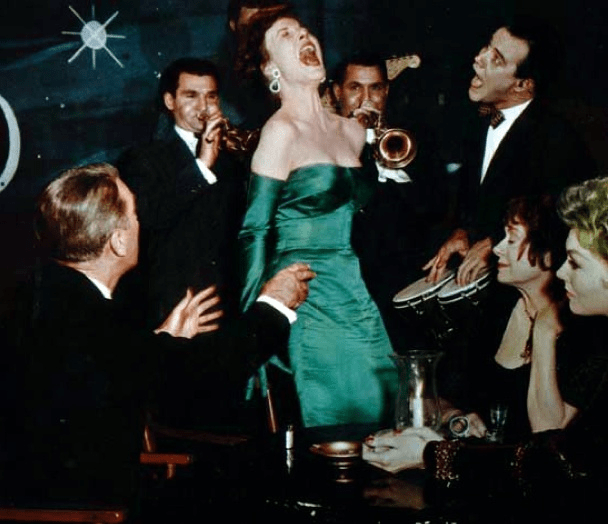
Anyway, before I get too carried away looking at images of green dresses on Pinterest, the point is that Merle herself is actually an interesting character. She went to college with Gillian and was known as something of a “beau-snatcher”; she once wrote an anonymous letter to the dean complaining about a girl attending class barefoot. She is deathly afraid of thunderstorms. She agreed to accompany her fiancee to the Zodiac club, where the musicians torment her until she leaves (granted, she had just insulted one of them, the perfectly gay-coded and bitchy Jack Lemmon). I’m not sure what she does for a living, but she has a nice apartment to herself, though Jimmy Stewart rightly asserts that she needs to redecorate, and she paints in a skilled abstract style that is too confusing for him. After he jilts her on Christmas Day, she refuses to take him back. Yeah, she is kind of unpleasant, but she has a rich inner life. She was simply with the wrong man, and it took a bit of witchcraft to convince them both of that.

“A tramp masquerading as some sort of social secretary.”

Miss Pettigrew Lives for a Day  (2008)

I got here via “If I Didn’t Care” on Spotify. It was one of the few 1930s songs on a “Jazz from 1930-1950s” station (lots of Nina Simone who, though wonderful, was born in the thirties).

This movie is like a play. I could have sworn it was adapted from a play, the way there seem to be three major sets that people move in and out of; the way there seem to be three main acts; the way Lee Pace seems to be thoroughly enjoying himself. But it was never a play. Just a book and a film.

But Frances McDormand is wonderful and just won another Oscar. “As a vicar’s daughter, I found her rather difficult.” True story: we have a beer named Tipsy Vicar, and I’d say about 35% of Americans pronounce it VI-car. It’s vicker.

Edythe Dubarry, Moaning Myrtle, on making over Mrs. Pettigrew: “Hang it all, the bone structure’s there. Why the devil not?”

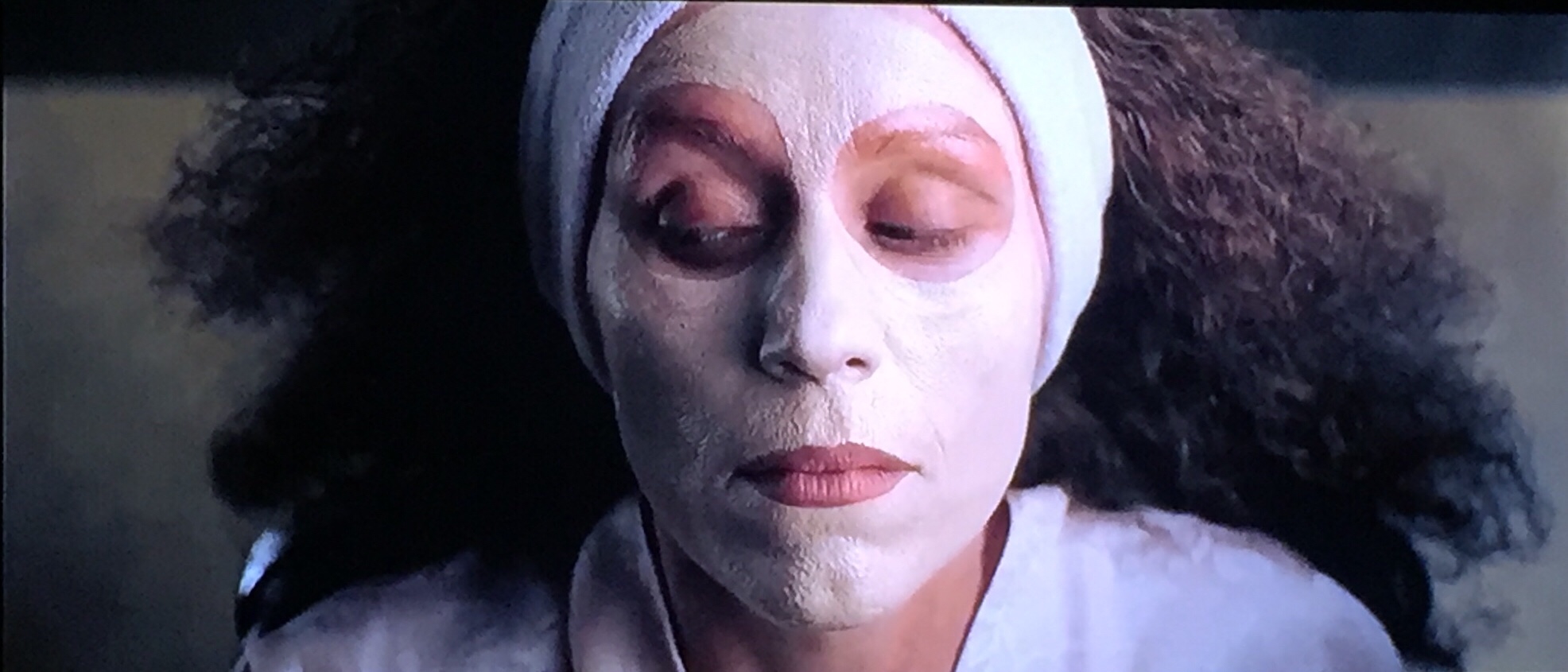
These cucumbers slices, and a few martini olives, are all she has to eat that day.
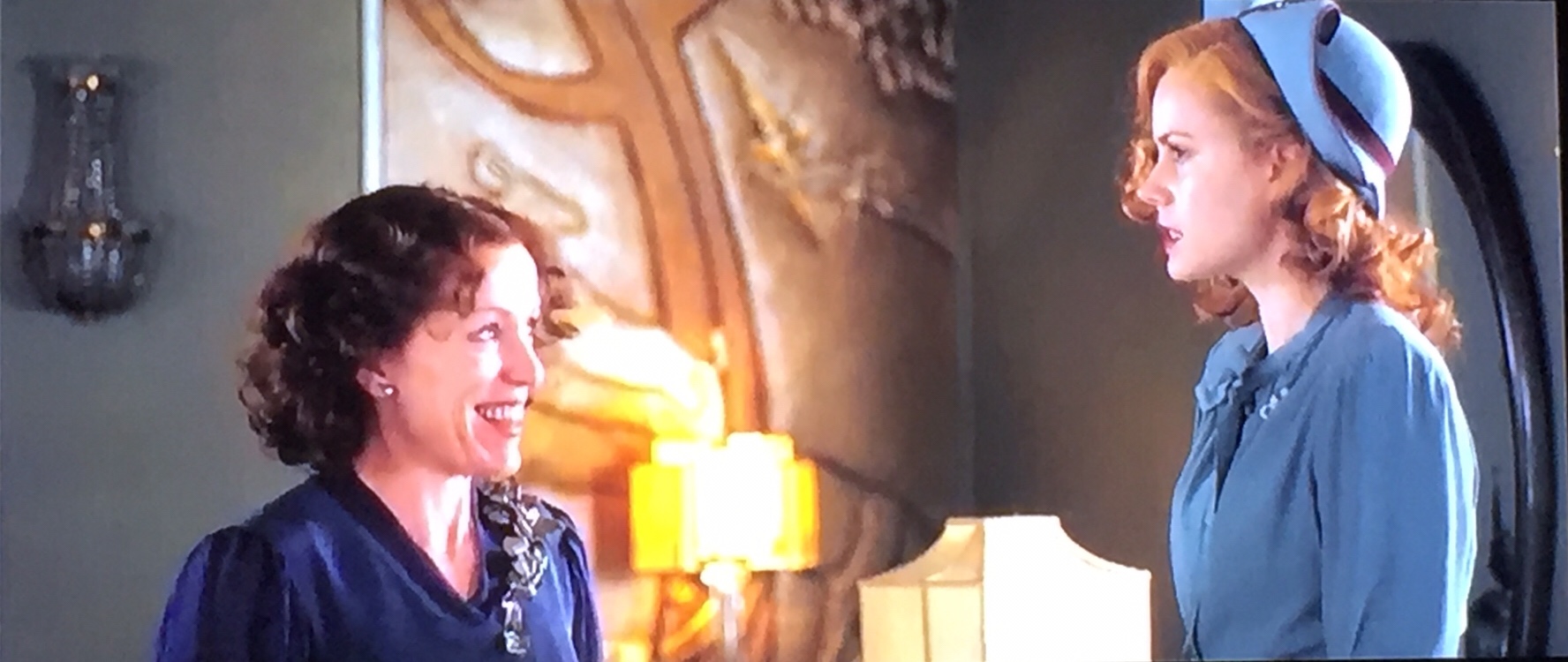
Lee Pace tried to steal a diamond from the Tower of London. “Thirty days bread and water.”

I love how charmed and delighted Mrs. Pettigrew is when Michael arrives on the scene:

“He is…”

“Impossible.”

“…magnificent.”

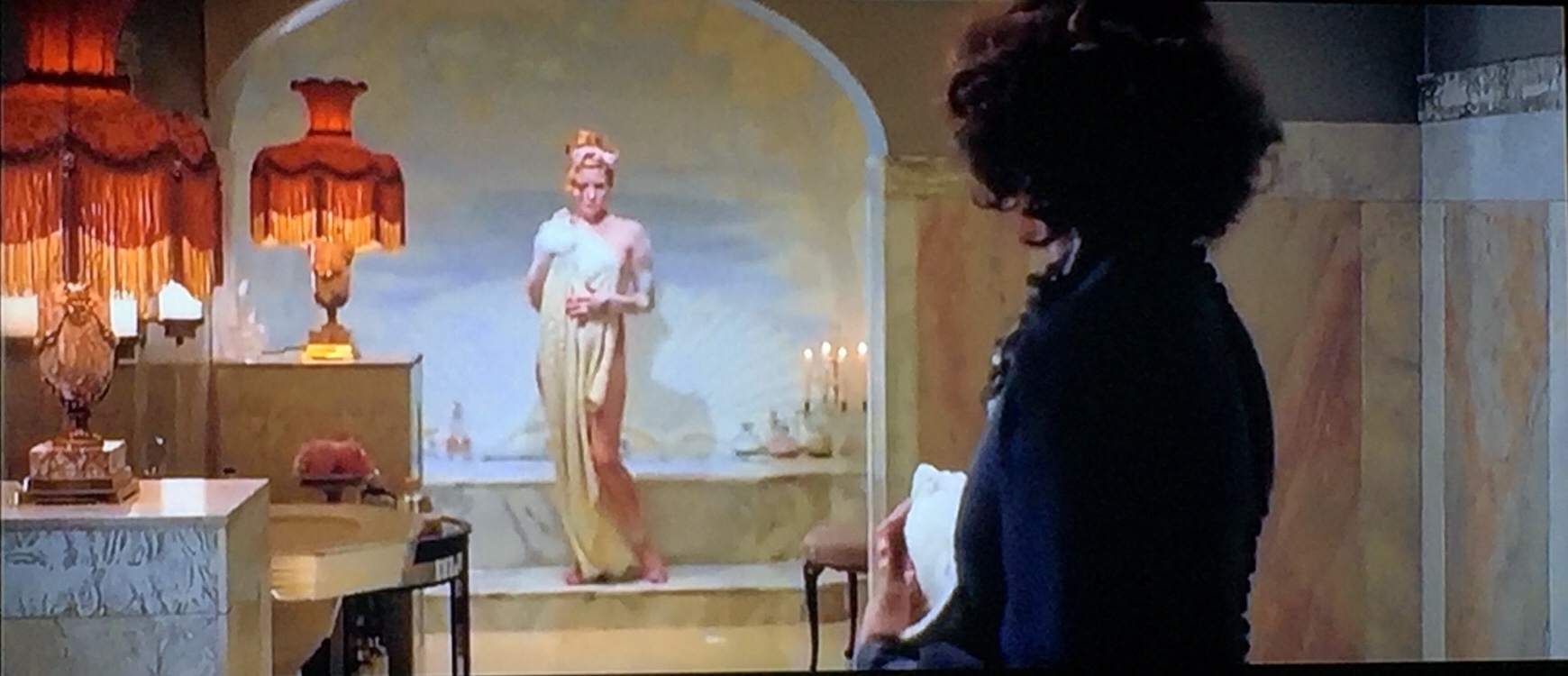
The Birth of Venus recreation: “You are beautiful, Delysia.”
Tipsy Mrs. Pettigrew! “Now, Phillip, how are your deliberations over Pile on the Pepper proceeding?”

“They don’t remember the last one.”

Finally, London rain.

“You have lost a man who loves you for who you are, not for who you pretend to be…I am an expert on the lack of love.”

And a London cabbie.

“This is all I own, Guinevere. And two dozen pair of shoes. For all the fancy apartments and fashion shows, do you know how close I am to having nothing?”

Change of program: “If I Didn’t Care.”

Ah, and the very London early morning walk home from the bar, when it’s completely light at 5 a.m.

Is Delysia pausing because she’s too sad to say goodbye, or is it because she’s just realized she can’t pay Mrs. Pettigrew?

“We learn to always keep smiling, even when we’re out of Bloody Mary mix.”

In the next installation of rewatching movies that are themed to the piece I’m editing, we had a book about a stewardess in the 1930s. I present to you View from the Top, also known as the Gwyneth Paltrow flight attendant movie. Crucially, this one also features Christina Applegate.

The year was 2003. I was still in college, but I had TRAVELED, man. I was worldly.  And I still dig this movie. Check out the cast:

Right away, we see John Francis Daley, the kid from Freaks and Geeks, as Gwynnie’s stepbrother, Rodney. He has like one line. Her high school sweetheart is Marc Blucas, post-Buffy (we know how I feel about Riley). He breaks up with Gwynnie in a birthday card, which is almost as good as a post-it (“Well, they don’t make breaking-up cards.”)

Presciently, Gwynnie is working in the Big Lots luggage department. “I’ve actually never been on an airplane, but, if I ever get to go on one, this thing is gonna follow me around like my own little dog.” She quits her job when Riley dumps her (“You’re a small-town girl. You belong here.”) and is sitting in a bar when fate calls to her from the TV.

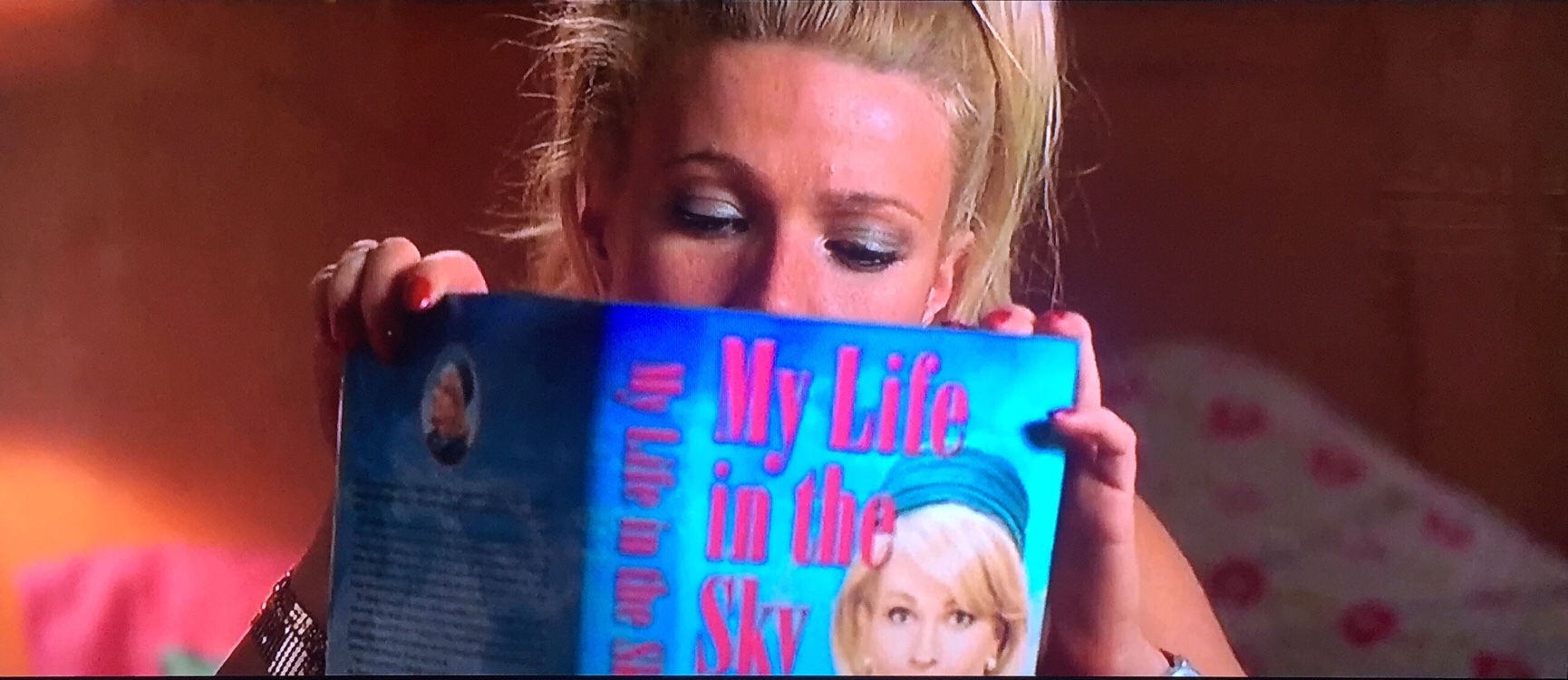
Sally Weston (Candace Bergen!) is from west Texas, billed as “the world’s most famous flight attendant,” and author of My Life in the Sky. “Sally Weston represents an ideal of poise and beauty and accomplishment that every flight attendant should strive to achieve.” I still think about Sally’s nostalgia whenever I walk through an airport: “It was different then. People dressed for flights.”

Sally provides Gwynnie with her mantra: Paris. First Class. International. “It’s the only route to happiness.

Along the way, we meet Kelly Preston, who once worked for Pan Am but can’t pass an interview for Royalty: “That’s the way the cookie crumbles.” Rob Lowe, ex machina, as Co-pilot Steve: “You’re going places…I’m a pilot, it’s my job to know where people are going.” He doesn’t show up again in the movie, but makes quite an impression...

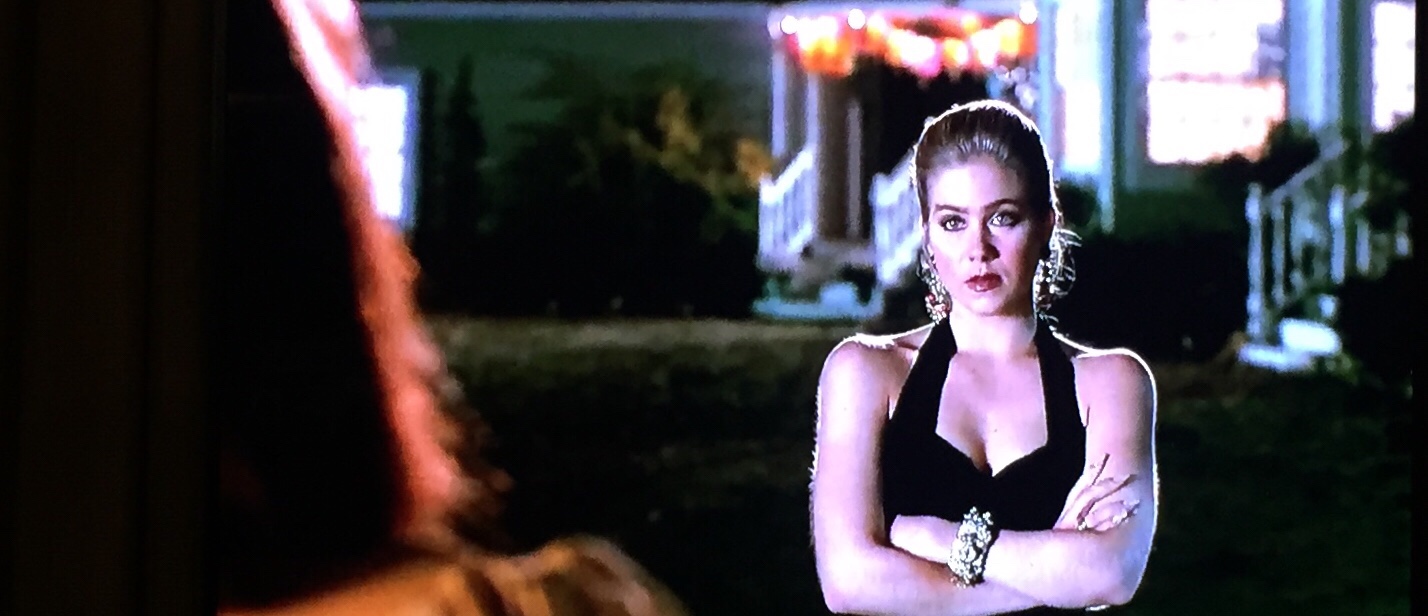
Gwynnie gets her own trainee attendent by the name of Christine (Christina Applegate!), and the three girls enjoy tanning at the houseboat on Lake Havasu (location of the original London BridgeI have pictures from a trip I took there around the time this movie came out). Here they meet Ted of lake patrol, a terribly tan Mark Ruffalo.

The classism becomes overt when some fancy flight attendants have to make a pit stop at Laughlin, Sierra Airlines’ hub. They flash Gucci and Vuitton, namedrop Chanel and Vuitton, and debate whether the guy in Rome or the guy in London bought the jewelry. Then they swan off, complaining of needing a flea dip, leaving our heroine to her Toblerone (which I always thought was super classythe Vuitton of the candy aisle, if you will).

They take a road trip to San Francisco, which I still think of every time I hear “Living on a Prayer,” and meet the legendary John Whitney (Mike Meyers!): “There’s no business like strabismus.” Donna and Christine get invited to the training center, which I thought was in San Francisco but must actually be in Dallas, since that’s where Sally Weston’s Rancho Esmerelda home is located. We meet fellow trainee Stacey Dash, and get some excellent grammar jokes from Mike Meyers: “An easy road comma don’t expect one” and “You put the wrong emph-ah-sis on the wrong syll-ah-ble.”

Shit happens, and Gwynnie gets assigned to Royalty Express, based in Cleveland, which is where Mark Ruffalo has returned to attend law school. She’s comparing High Style vs. Cheap & Basic outfits in a magazine when he approaches her at a coffee shop. Yay! They decide “Cleveland is like this great big giant waiting room” (gate would be more appropriate?) and fall in love while they’re killing time.

Christine stops through Cleveland (“I’m going for a more classic look. It goes better with Chanel.”) and turns out to be horrible. Gwynnie gets to retake her test, which Mike Meyers does not find fair: “So, you’ll be happy to know you got a perfect score. First time in seven years. The last time was me.” But he tells her to go do the damn thing, to do it for those of us who can’t. 

Gwynnie sheds her never-believable white trash skin and emerges a swan in a green and blue uniform…and the shoes! Christine attacks her on the plane (“Someone had to put you in your place.”) You’d think it’d be funnier to watch Gwyneth Paltrow get beat up, but the funniest part is Applegate flipping the bird as security hauls her away. Gwynnie goes on to lead a fabulous but lonely life in New York, when she’s not jetting around the globe. She sits alone in Paris in the same outfit from the magazine, though it’s unclear whether it’s High Style or Cheap & Basic.

Just when I thought we were out of cast members to get excited about, there’s Sex and the City‘s face girl Nina Katz (Nadia Dajani) as Paige. Speaking of pages (meh), Sally finds Gwynnie all-aloney in the Royalty lounge on Christmas Day in Paris and tells her: “Donna, I don’t think you read carefully enough.” You need a co-pilot, girl!

I had completely forgotten how this movie ended, and while I do regret the aviators I distinctly remember wearing around this time, the twist gives Rob Lowe’s appearance more gravitas and reminds us that we can dream of flying even higher.

Oh, I read a lot of things. I mean, you never know where the big idea is going to come from, you know?

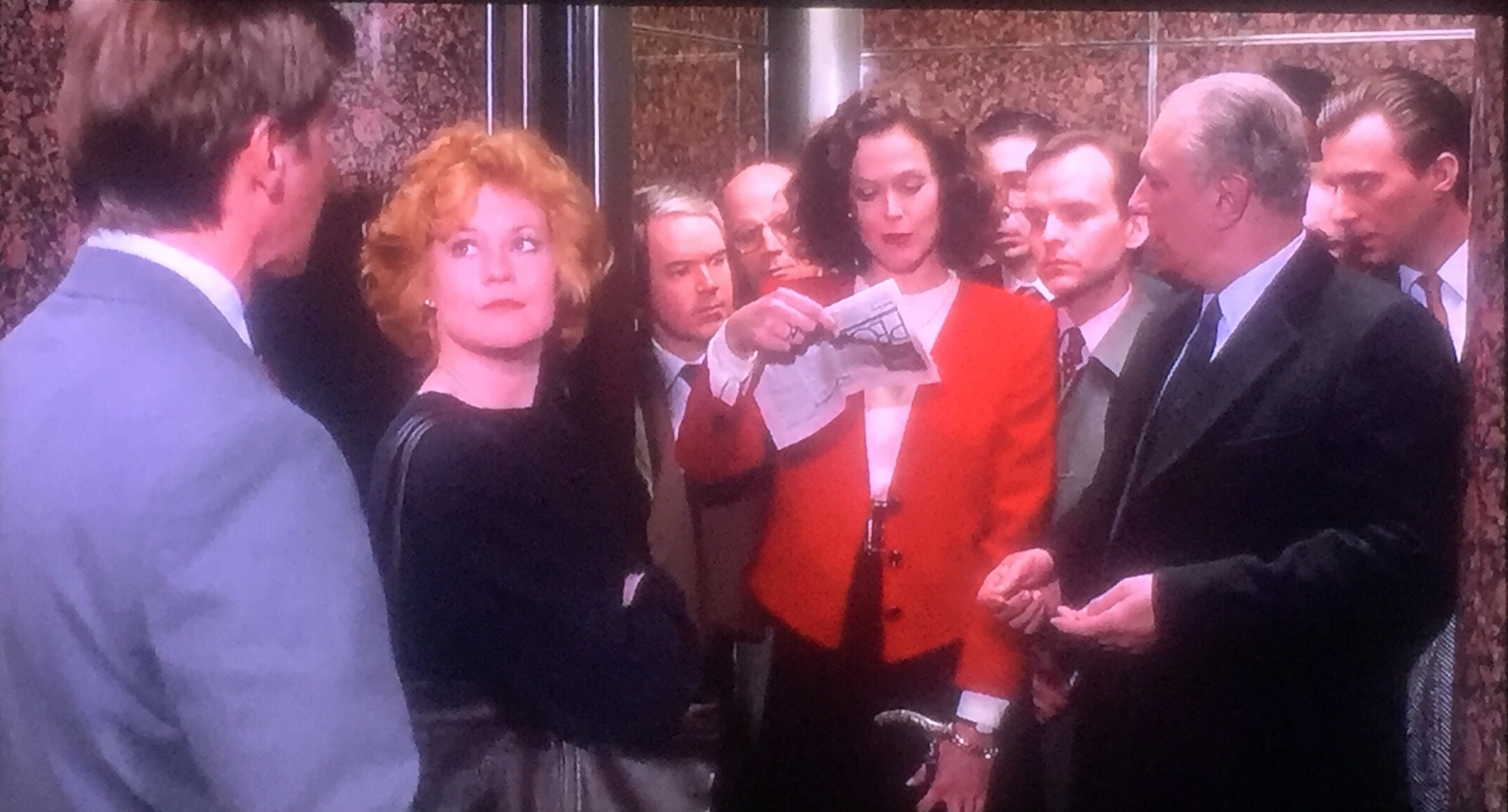
img_7362Working Girl (1988) is the consummate career girl movie, and though there are no working mothers in the film, I’ve included it because it can’t be escaped. And I’m a fan. I cracked up when a character referenced it during a panic attack on Greek (but only just now realized it’s because she and Sigourney Weaver’s character have the same name—Katherine Parker), loved when it came out in Bertie’s impression of an American accent during the tripping episode of Love, and I’m looking forward to the Cyndi Lauper–scored musical. It might be my favorite Harrison Ford role (yep) and ditto for Melanie Griffith.
kpark1

“I want to relax in my cushy, little corner office with my feetsies hanging over my desk while I try to convince myself I’m this generation’s Melanie Griffith, despite my clear resemblance to Sigourney Weaver due to our—extreme stature and height.”

The film opens with the ferry to Manhattan, and it must be inspiring for the commuters who actually get to see the skyline every day on their way to work. Griffith plays Tess McGill (great name), a Staten Island girl in the secretary pool on Wall Street. She wears sneakers on her way into the office, with polka-dot tights and heels in her handbag. She bounces around a bit—turns out, Kevin Spacey is a sexual predator—who knew? (Also, I held a door for Oliver Platt at SXSW 2014.) She gets splashed by a rain puddle, a la Carrie Bradshaw. But she also attended night school for a business degree. “Look, I’m thirty years old. It took me five years of night school but I got my degree and I got it with honors. I know I could do a job,” she tells Olympia Dukaki.

Tess is thrilled to go to work for a woman transferring down from Boston (Sigourney Weaver, in one of my least favorite of her roles, though that’s more about the character than her performance). Classy, educated, and connected, Catherine is everything Tess is not…and two weeks younger. Her office window is visible from Tess’s commute. She quotes style advice from CoCo Chanel. “I consider us a team, and as such, we have a uniform: simple, elegant, impeccable. ‘Dress shabbily, they notice the dress. Dress impeccably, they notice the woman.… You might wanna rethink the jewelry.”

Tess’s contribution to the team includes suggesting the little Chinese dumplings she read about in W (“You read W?”), which is great until Tess gets to push the steam tray around. She admires how smoothly Katherine brushes off a guy: “Never burn bridges. Today’s junior prick, tomorrow’s senior partner.” Tess pitches her acquisition idea on Katherine’s birthday, evidenced by the balloons and flowers covering her office. Katherine asks Tess if she overheard the idea somewhere, say, on the elevator. Katherine smokes in her office, probably the carton of Larks Tess brought in earlier. The entrée program Tess has been applying for appears to be something industry wide, or Tess has been moved to a different position within the same company… Are those the same elevator banks? Is Olympia Dukakis representing a temp agency or human resources?

Tess tells Mick (Alec Baldwin, hilarious) that Katherine wants to be her mentor and raises the possibility of a double date in the city. Katherine, who went to Wellesley and speaks fluent German, has indicated she’s “receptive to an offer” of marriage. “Watch me, Tess. Learn from me.” After Katherine breaks her leg on a ski trip, Tess becomes more like a personal assistant. (The passcode to Katherine’s parents’ town house is 7543200, BTW, and they may have a Warho.) As she’s using Katherine’s voice memos to practice elocution, she learns Katherine has stolen her idea. Tess drinks a Coors Light tallboy on the ferry home, then catches Mick in bed with someone else. (“No class.”)

img_7303The idea is a loophole that protects a media company from buyout, and to my mind, it’s a good one: smart business, knowledgeable about policy, not afraid to mix high and low culture, and it keeps everybody happy. A lot of my appreciation for this movie hinges on how perfect Tess’s idea is for her character. Catherine writing that “there’s a lightbulb over my head” is the perfect way to present her treachery…that’s just bad writing. If someone emailed you that today, you’d cringe too, and I think we see that in Jack Traynor’s resistance of Catherine’s advances (he sure as hell banged her, though).

Tess stares pensively at her old life out Katherine’s office windowbefore making the call to Jack Trainer. His Who’s Who in American Business profile reveals he has degrees from Dartmouth and Harvard, making him the exact type of person with whom Sleazoid told her she couldn’t compete. It also says, and I never realized this, that he was married from 1972 to 1978 to one Susanna Rockwell. He’s also forty.

Since “fringe times are crucial,” Tess raids Katherine’s closet (the dress still has a $6,000 price tag on it, but “It’s simple, elegant. It makes a statement. It says to people: ‘confident, a risk taker. Not afraid to be noticed.’ Then, you hit ’em with your smarts.” She and best friend Joan Cusack also raid the medicine cabinet (“Valium. In the convenient economy size.”) Tess goes out and meets Trainer, though she doesn’t know he’s him, and he compliments her on actually being dressed like a woman. We get the “bod for sin” line, but she also greets his toast, “Power to the people,” with her own, “the little people,” under her breath. Her creepy boss sees her across the room, someone else hems her in at the coat check, and she makes this irresistible play for Trainer’s affections:

img_7305

By the way, I used this exact move on my boyfriend at a party a few weeks ago, and it worked! He took me home. (Granted, we live together.)

Cyn gets to be Tess’s secretary for a bit, and Joan Cusack has a lot of fun: “Let’s give her a shout, shall we? You decent? A Mr. Jack Trainer to see you, Ms. McGill. Hold all calls, Ms. McGill? Can I get you anything, Mr. Trainer? Coffee, tea, me?” He’s enjoying it. Tess confronts him for lying about his identity (“All mergers and acquisitions. No lust and tequila.”) I also forgot, he buys her a briefcase!

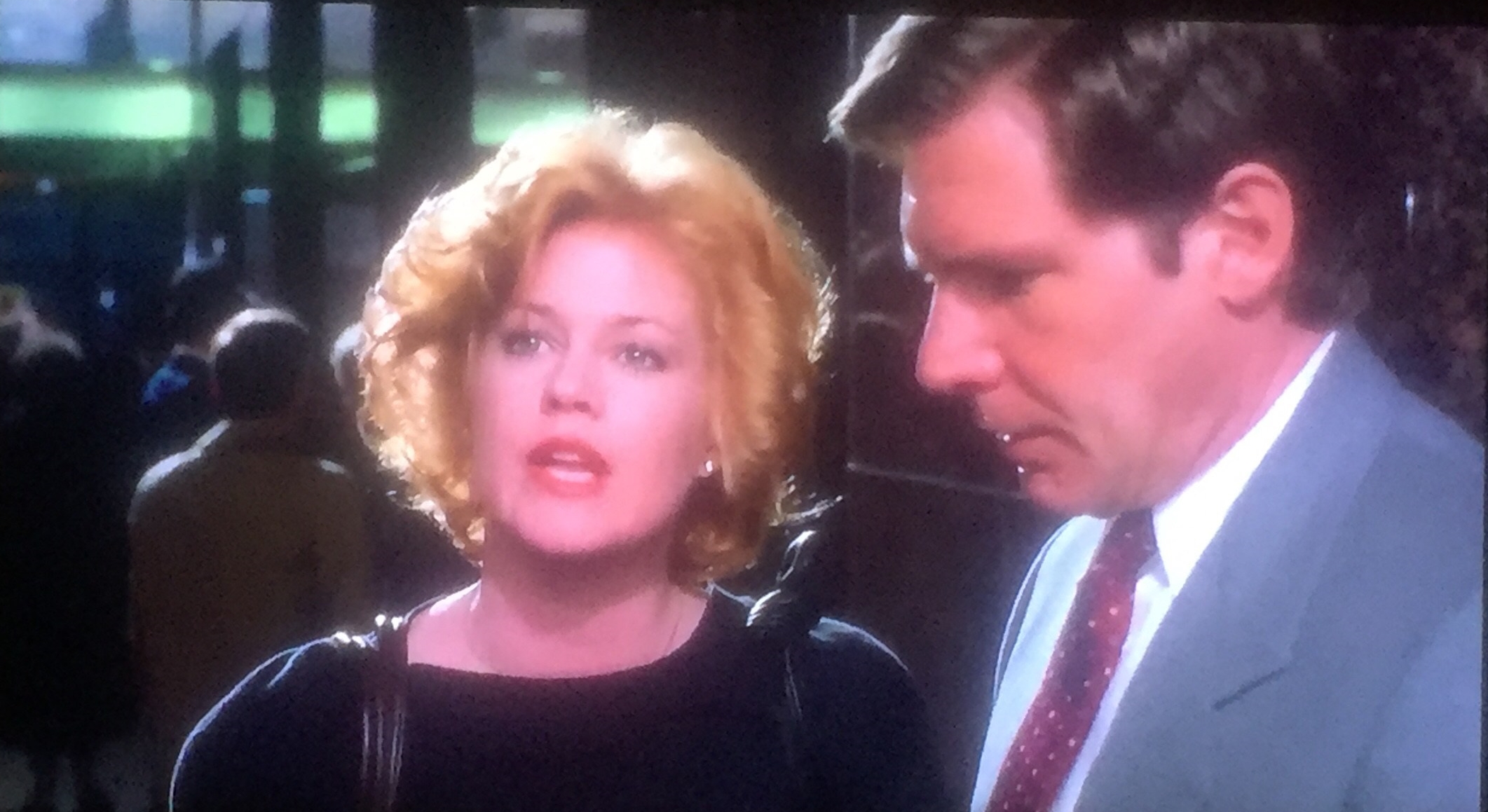
img_7358For me, this is peak Harrison Ford because you get the Indie capableness without the Han Solo swagger. He takes a spit bath in his office with the blinds open and gets a round of applause from the secretarial pool. He looks stunned with tzatziki on his lip and opens the door to the Chinese food delivery guy wrapped in a blanket. Yes, he stumbles as a hero when blindsided by Catherine’s outburst in the meeting, but even he joins Tess in exacerbation at Catherine’s damsel in distress act.
img_7341

Catherine, who has to be picked up at the helipad. Catherine, who took a muscle relaxer for the flight (“Oh, let’s all have one, shall we?”). Catherine, who’s had weeks to come up with an explanation for the memo. Catherine, who says Jack loves Shalimar. Catherine, who actually mimics the ticking of her biological clock, panting, “Let’s merge.” Catherine, who behaves likes every disingenuous spoiled bitch I’ve ever known, to whom I only wish it had occurred to me to say: “Do not ever speak to me again like we don’t know what really happened, you got me?”

img_7346When Jack finally comes through for Tess in the end, he gives her the floor. Yes, he has to contend with his johnson, as Trask jokes at ground level, just to help her get her foot in the door, but as Tess tells Trask a few minutes later when they reach the top level, there is no way for someone like her to play the game without bending the rules a little. While Mick proposed at someone else’s engagement party, while the girl he cheated with looked on, and screamed, “Who the fuck died and made you Grace Kelly, huh?” when he didn’t get the answer he wanted, Jack tells Trask: “Hear the lady out, sir. Here’s another elevator.”

It took me many viewings of this movie and going through a point in my life when I was reading a lot of business self-help before I finally noticed that it all leads up to an actual elevator pitch. Tess is so honest and committed, knowing she’s only got Trask for a moment while everyone else is stuck in a different elevator car, so you just can’t help but root for her. Even though she acted like a certifiable maniac to get in that position.

Seriously, isolate her behavior and it looks positively criminal: identity theft, fraud, trespassing, substance abuse, illegal occupation, and wedding crashing (while wearing white, WTF?). Jack was party to that last one, though she only told him on the way there; he wound up enjoying the game. (“You wanna do it? Do it.“), and that’s kind of how we know he’s going to (eventually) be understanding about the rest.

I think that’s what gets me the most about this movie. Having a Harrison Ford, a partner in crime, who comes through for you instead of being a coward and allowing the Catherine types to revel in your heartfelt mistakes. (“But you’re lying!”) I’ve been thinking about this a lot lately, how we don’t get rewarded for being genuine in a system that’s stacked against us, even though the movies told us we would. Only certain people are allowed to be genuine.

And yet…

img_7350

“Spider-Man kicked me, and She-Ra took Maggie’s snack.”

One Fine Day (1996)

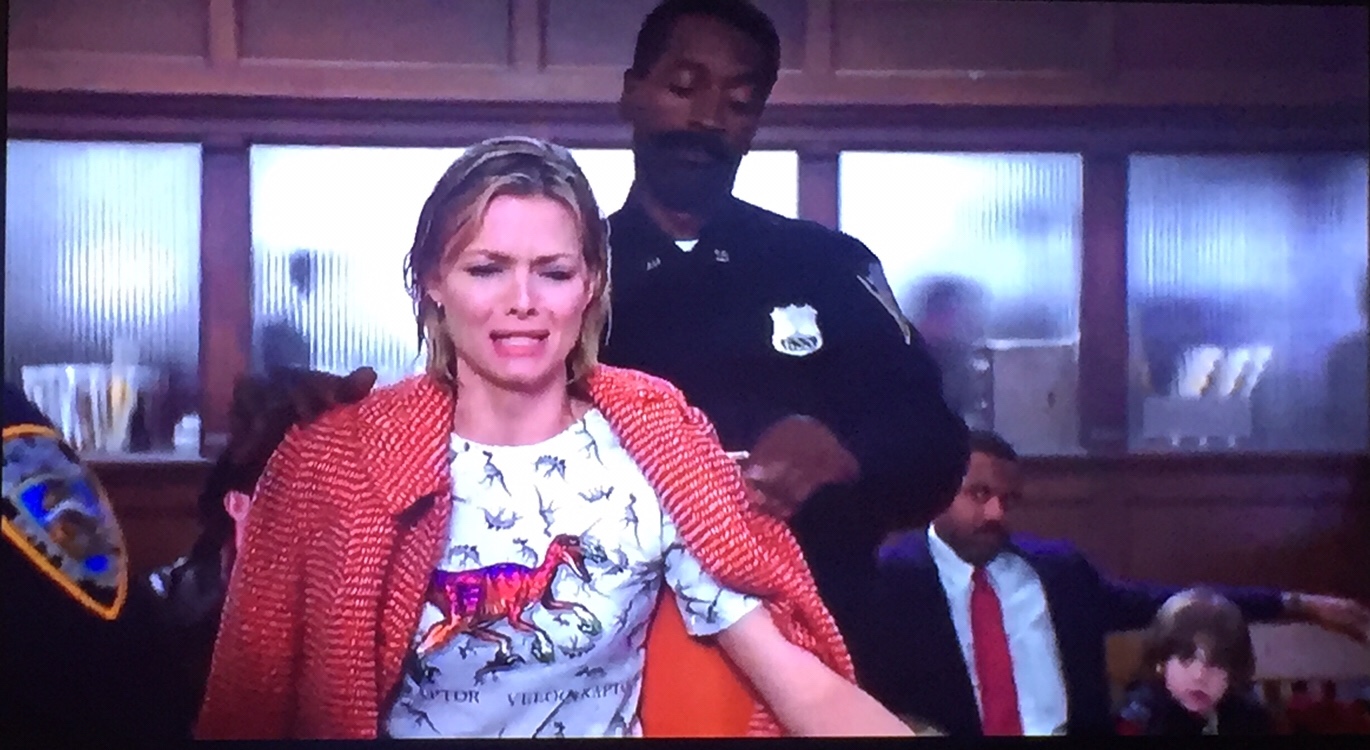
Never a favorite, but it’s got peak Caesar-hair Clooney and Michelle Pfeiffer, that white gold.

Natalie Merchant singing a slow version of “One Fine Day.” I had convinced myself it was Norah Jones, although this movie was before her era of domination.

Opening Hitchcock-esque shot: A man playing piano. A golden retriever waiting at the door! An old couple together. Michelle Pfeifer paying bills with envelopes and a checkbook!

But here’s the thing: Mae Whitman is Maggie.

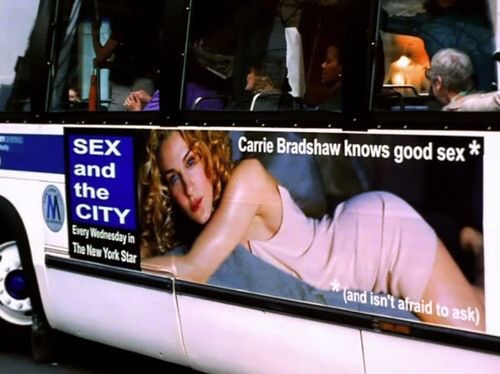
Clooney is on the side of a bus! Daily News advertisement: “You don’t know Jack.” But Carrie Bradshaw knows good sex*

*(and isn’t afraid to ask). Wait! SATC started in ’98. I couldn’t help but wonder: Did they callback to One Fine Day for the opening credits?

Kids go to Montessori and the school bus actually passes both parent-child sets before they all meet up at the pier.

“You know, I have a day.” Michelle, giving some excellent bitch. “Derived? You must be a writer.” But just look at her!

Exquisite.

A Hilary Clinton joke! “A real superwoman: can’t open her door, won’t shut her mouth.” “Excuse me? Are you talking about me?” “The first lady. We’re thinking about doing a piece on her.” Sigh. I wish this were more relevant.

The kids miss the field trip. My mom used to let me skip mine. I never visited the state capitol until I did so willingly as an adult.

HOLLAND FUCKING TAYLOR is Michelle Pfeiffer’s mom!!! I’d totally forgotten this. She plays a mean Ann Richards. I love her. And I want a spring spa day.

“Maggie, when you grow up and are incredibly beautiful and intelligent and possess a certain sweetness that’s…that’s like a distant promise to the brave, to the worthy, could you please not beat to a pulp every miserable bastard that comes your way simply because you can? Could you not do that?” I kinda love this.

Remember Amanda Peet?

Jack’s editor has a cat in his desk drawer! “This is Lois Lane. She lives here in the news room.” Annndd…she eats the fish. I never noticed that.

A lot of split screens in this film.

“You know you’re not the only with a day. I’ve got a day too.” Clooney, trying and failing to bring the bitch.

Drinks at 21! That and the voyeurism of the opening and closing sequences is a callback to Rear Window.

Spanish-speaking maid giving Clooney some issues. Just use Denzel’s trick from Inside Man—yell in the street until someone who speaks that language helps you.

I want a spring spa day!

“But you’re not a control freak?” “No, I’m a single working mother.” Oh, right…I was supposed to be looking out for that.

Serendipity-esque Serendipity frozen hot chocolate…for which Michelle Pfeiffer does not pay the bill.

And you have a cat now.

“You know nothing about politics. You know nothing about journalism. You and your little friend in the outfit…”

“Say it for your kind.” Gross, Clooney. You lost me.

“First of all, I thrust my column in your face because I thought you were the most beautiful woman that I have ever seen in my entire life and…I…I wanted to make a good impression.” Dammit, he got me back.

I want a travel hot brush.

“Lois Lane ate the class fish.”

“It’s so obvious, Daddy.” And he’s fishing in the pet store fish tank barehanded, like a bear…

More Michelle!

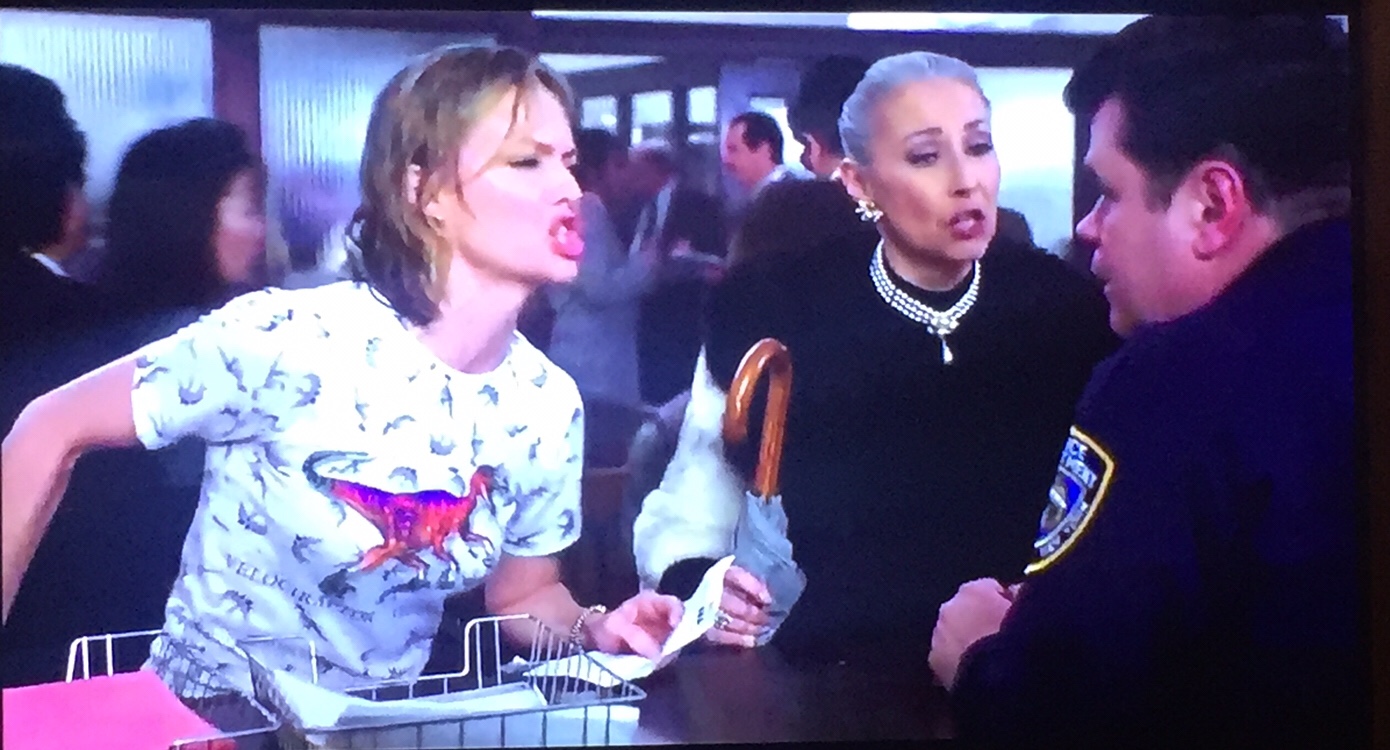
Velociraptor! Rawwwrrrr!

“I’m right on top of that, Rose!”

First in my “movies inspired by the book I’m editing” series. The manuscript was about a working mother, trying to balance it all, so I made a list
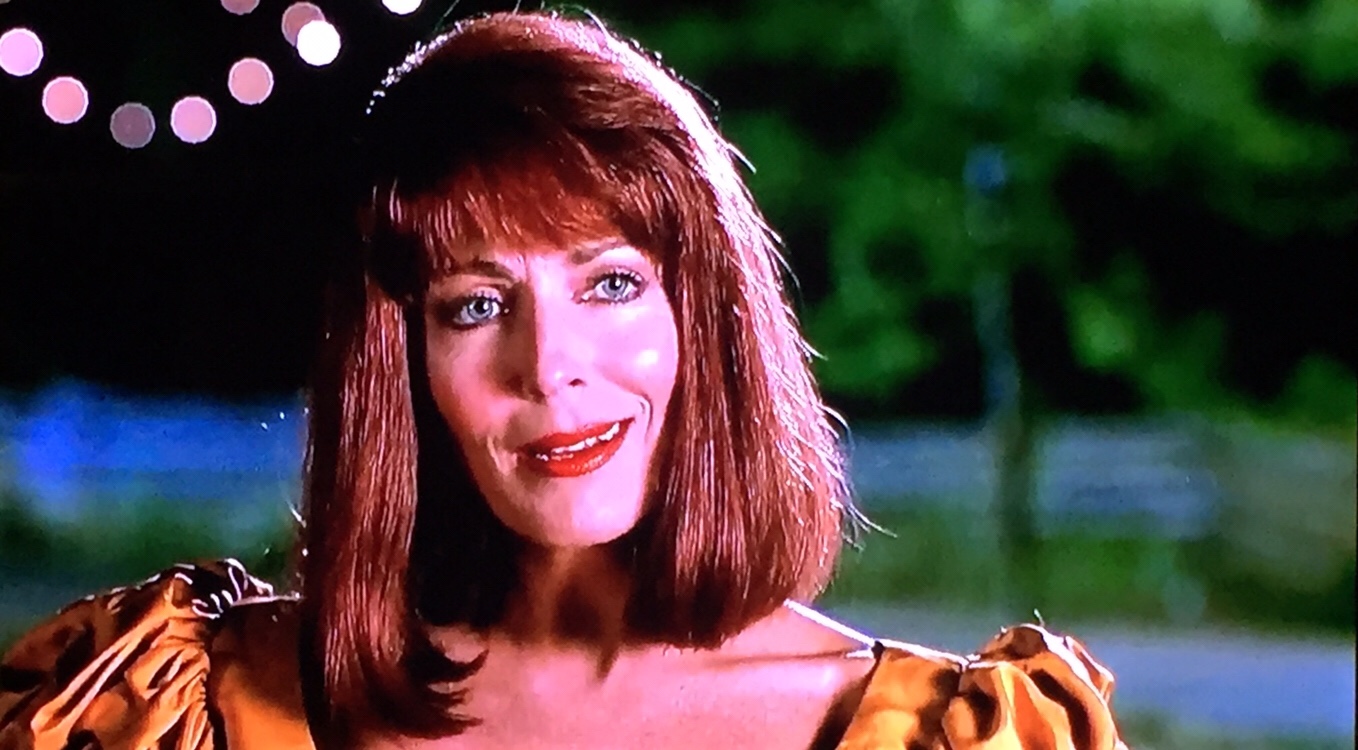
Here we have the cult classic Don’t Tell Mom the Babysitter’s Dead from 1991. This is my origin story when it comes to cinematic working women. I have a memory of watching this in the theatre with my cousin while our grandmother watched JFK, but there seems to be a six-month gap between the release dates. I would have been eight or nine. I can still see how annoyed she was with us when our movie ended first and we went to find her during one of her movie’s most crucial scenes.

First thing, I’m cracking up at Mom’s line, “Because I’ve had a very rough thirty-seven years, and I need a break,” which is spoken by Concetta Tomei (no relation), who was forty-six at the time the film was released. (I, by the way, am thirty-five and do not have one kid, let alone five). The freedom with which seventeen-year-old Sue Ellen smokes in front of her mom is also pretty funny.

And here’s Kenny, Keith Coogan, Brad from 1987’s Adventures in Babysitting, probably my favorite instance of stunt casting ever, and one I only figured out about six years ago. I never realized he gets the only “fuck” in this PG-13 movie, when his brand new potted pot plant falls off the window ledge.

The only mention of bio-dad: “What about Dad? What about blackmailing Dad?

When Mom calls, Swell tells her Mrs. Sturak has a date with a mortician, which is true.

Swell’s fashion sense: Stevie Nicks meets…Blossom?

Pausing on her resume, I noticed Swell not only made herself a Vassar gal, but she gave herself an MA from the Fashion Institute of New York…and later, when Rose glances over it, there’s a Vogue summer internship. Bell Jar reference? Some of that “glamorous fashion stuff. Her address is 201 Bent Rd and her phone number is (213) 353-8361.

The close-up of Applegate’s bushy eyebrows!

Really bad dubbing of “Liza?!?” in the drag queen car-theft scene. Apparently, the original line was “Shit!”

Ah, Bryan, you sweet, sweet nerd: “It really cracked Mr. Egg when you left.”

And never forget, the fax machine burps at her.

Cathy, who loves QED reports, is already known from Twin Peaks at this point and will also feature as the voice of Fifi the feather duster in that year’s Beauty and the Beast. Her Twin Peaks co-star, David Duchovny, is simultaneously playing the crossdressing agent Dennis/Denise Bryson at the time of filming.

The cucumber joke…my best friend and I used to argue about the implied innuendo there. I said there was one; she said there wasn’t. She was always considered the experienced one.

Kenny’s Julia Child-inspired cooking rampage reminds me of my boyfriend.

Carolyn is telling her brother to call the girlfriend, then changes her tune midstride to tell him just to forget about her.

That Kenny was with-it enough to tell the hospital Walter was Sue Ellen’s son is impressive.

“They’re all just a bunch of old whores,” Rose says about the fashion buyers.

Setting up what I’d been waiting for this whole rewatch: “Life’s Rich Tapestry” from Modern English. When I first started grooving to this song on Spotify, I couldn’t place it to a scene, so I thought it must have been the closing credits, but it drops in as Rose and Sue Ellen are talking and really picks up when Kenny and his stoner bro are sitting on the bridge across the pool. It’s all the happy ending stuff, which makes me very glad. It fades out as Swell approaches Bryan, and that’s so “I Only Have Eyes for You” (their first-kiss song) can pick up again.  And I still think “Swell, what are you doing New Year’s Eve?” is a sweetly romantic line, if a little nerdy.

One of the funeral home workers is also named Brian. Odd. When I was a kid, I didn’t get the joke, and I thought he was Walter all grown up (they have the same hair).