Hold up, am I the mom?

Dig, if you will, this picture…of me and my cheese plate engaged in some bliss:

cheeseplate

The photo was taken six months ago in a wine bar during a social gathering for the Local Yuppies, the creative class / talent development organization of which I was then vice president. There were about 30 people in attendance, but only two board members, and the absence of the president made me the ranking officer. Since I was under pressure to take over as president for the 2016-17 fiscal year, it was a chance to see how I would run the organization.

I had gotten to the wine bar early, ostensibly to make sure everything ran smoothly, but mostly because I was excited about my new daily planner and wanted some alone time: just me, my planner, a glass of wine, and, most importantly, some food. I was starving.

Alas, at least three other people decided to be early, so I had to start performing my duties the moment I got there. I ordered my wine and food as quickly as I could, then set about networking, a word of yuppie origin that loosely translates as “talking to people.”

I eventually found a tall chair and sat with a new attendee while sipping Pinot Grigio. My cheese plate arrived and it was huge. For $10, I got a smorgasbord. The woman delivering it to my table asked if I want honey or hummus. “Can I have both?” I asked, and she said of course. This in addition to the cheeses, bread slices, crackers, fruits, chocolate deserts, and scone. A scone. The cheese plate included an entire fucking scone.

At the same time I was managing my hunger, I was also managing Local Yuppie business, greeting people and posing for photos. I scolded a few book club members for not showing up to that contentious May meeting. At one point, I had to go to the front of the room, leaving my table companion with the suggestion to eat whatever she liked off my plate.

In my travels to the front of the bar, a distance of about 20 feet with about that many people in the vicinity, two separate individuals stopped me to ask me about the cheese plate. See, our social venues usually (but not always) provide free appetizers to pair with the drinks we are buying. However, since this social had been planned at the last minute, there would be no free nibbles that night. Upon seeing the giant plate of food at the table of the acting president, it was perfectly reasonable for some members to assume it was a shared plate.

So I shared. I told people it was my food, but there was plenty of it and they were welcome to pick off the plate. Over the course of the evening, I watched my apple slices, an entire cluster of grapes, three out of four bread slices, and one of my chocolate desserts disappear from my plate. One girl sat down in front of me and ate that entire fucking scone while telling me how awesome she was and how she would run things if she were in charge. I finally interrupted her to crumble off a corner of the scone, just so I could find out how it tasted.

It was around this time, watching my food go travelling off my plate whilst dispensing career advice and volunteer opportunities, that I had this exact epiphany:

Yes, apparently I am the mom. And my kids were hungry. So I fed them.

All this time, I’ve been wondering what the organization could do for me. In two years, I have hired only one writer through the LY network, the original reason I joined the organization. I don’t see it advancing my own career either, partly because publishing isn’t really a growth industry around here, and partly because I’m 30-something and more advanced in my career than most if not all of the LYs. Some of them are barely out of college. But it does raise questions about mentorship and paying it forward and how I can truly develop some leadership skills, instead of shrugging off the chance to take charge because I don’t like responsibility. We’re all adults here, yes, but some of us are more grown than others: when the waitress took my empty plate away, I noticed not a single person other than me had ordered food.

With service to any organization, the rewards aren’t always immediate or even visible. It’s November now, the new fiscal year, and I did wind up being president of the Local Yuppies. I’ve avoided the word “leadership” since high school, so it’s odd learning to steer a ship again. Today, I went to lunch with one of our new board members to make plans for the holiday charity season. She said she didn’t often get asked to lunch and appreciated the invitation.

Then she paid for my food.


Content with Content

[*This is a draft from a year ago. I redacted the details.]

I’m writing my first article in three years, and I’m struggling to get where I want to be. I have the basic angle the editor asked for, my own interest in the topic, and a buttload of quotes from relevant people. However, the article is not quite doing what I want it to do. I want it to be funny and fresh, not boring and overdone. I’m not covering breaking news, and I need to be able to impose my own worldview on this piece.

And lately I’ve been panicking that I have no worldview, that I don’t know where I stand on [redacted] and therefore I must be a cardboard cutout of a human being. Especially since we’re looking at starting our own chapter, I wonder what we could be doing differently, or if I’m just trying to reinvent the wheel. We had [redacted], and not enough people signed up. We don’t need to be doing more stuff; we need to do the stuff we’re doing better.

And then I’m looking at how I need to be a content writer, not just a writer, how I need to package myself and my writing. And this is all really interesting to me but now that I have a chance to put it into action I’m balking. Because I ALWAYS have this problem and I’m a terrible human being and I will never succeed at anything. This is exhausting, and it’s getting a little old.

So let’s try something new and believe in ourself/ves? Believe in elves.

The first thing I need is a title. It will probably be changed, but it’s basic that I should craft one anyway. Maybe I need an outline as well.

  1. Children
  2. [redacted]
  3. Nonprofit Organization

You’re stalling. Scared to make a call. Looking for permission, or call it research if you must.

What do people need to know?

I wrote some more last night, reading the research by the pool. I’ll put that into my document after I’ve retrieved it from the car, but I don’t think this is very good. I’m not happy with it.

What I want to say is that [redacted] are people who don’t actually use the [redacted], just want to support its continued existence. But I have to say that in a way that 1) considers that some of them will insist they actually do use the [redacted] and 2) doesn’t raise class division issues and 3) is funny.

You’re balancing:

  1. What your editor wants.
  2. What the reader wants.
  3. What you want to write.
  4. The information you have.
  5. What the subject would like to see written.
  6. What is good for the world.

People nowadays prefer listicles.


Beck and Hunt


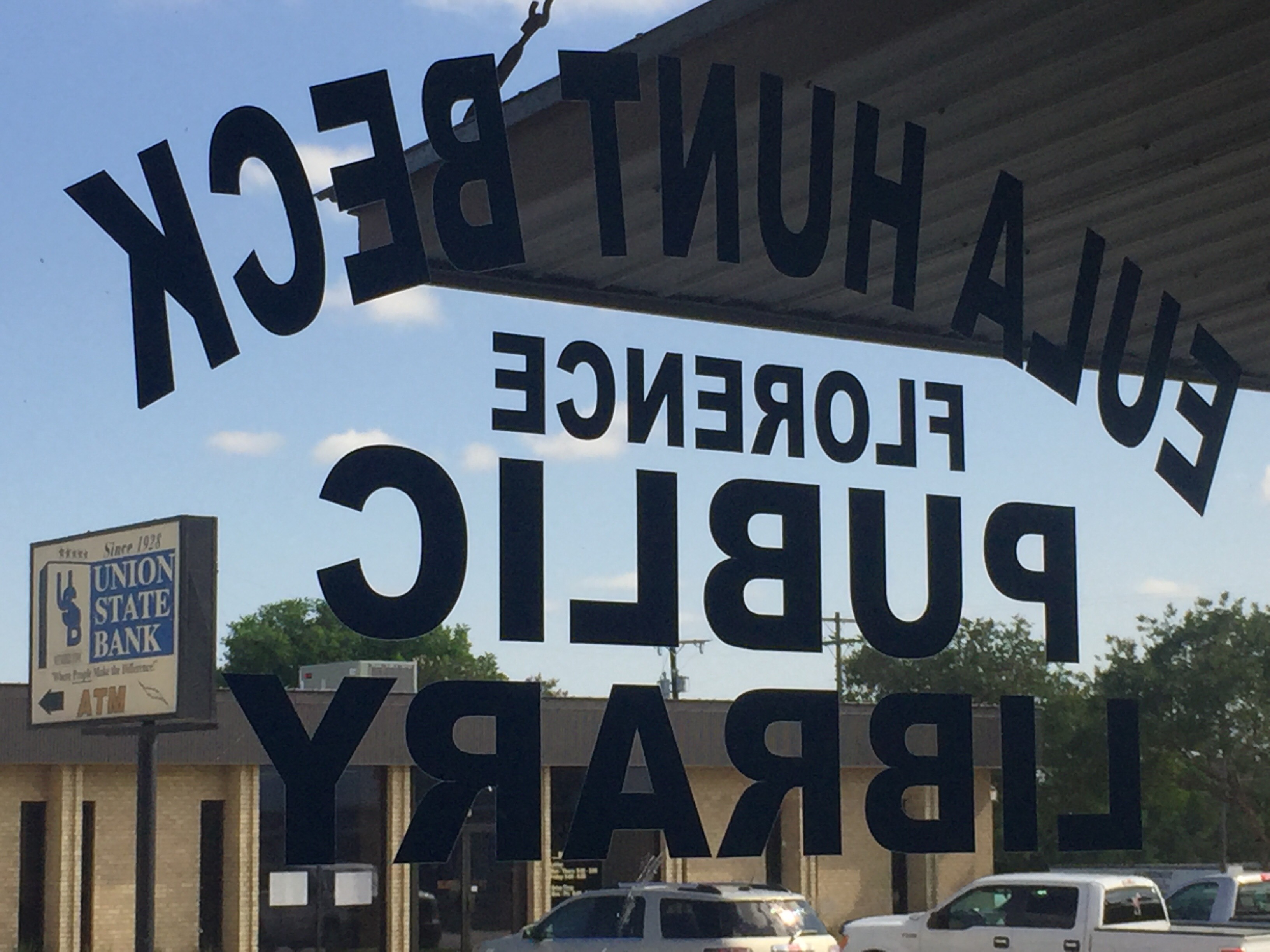
The library in my town is officially named the Eula Hunt Beck Florence Public Library. While I have reservations about the SEO confusion (Eula and Florence are both traditional female names, while Hunt and Beck are verbs) the name was intended to honor “Sis” Beck, the reigning matriarch of our town’s banking dynasty. She has made many notable contributions to this whole region of Texas, and has probably done twice as much anonymously. Plus, she’s always been nice to me.

A woman came into the Eula Hunt Beck Florence Public Library today brandishing this book. It’s a well-loved 1980 custom publication of local history printed by Nortex Press in Burnet, Texas. (!) Nortex Press was part of Eakin Press, which has since been acquired by Wild Horse Media Group in Fort Worth, which is doing some interesting stuff…but once upon a time, they were publishing books in Burnet friggin’ Texas!


I can’t be the only one who looked at that cover and thought Willie Zell Ray Hunt must have been a warlock. 1768-1980?!? Dude was 212 years old! Alas, it’s just the time period researched in the book (which kind of looks like an old hymnal, no?).

Willie Zell Ray Hunt was actually a woman, and, according to her obituary, a midwife. Though not quite 212 when she died, she did live an impressive 94 years and published a book at the age of 77. She is buried in Maxdale Cemetery and was survived by two daughters, one of whom is Eula Lea “Sis” Hunt Beck.

What happens to a dream unheard?

Harlem (1951)
by Langston Hughes

What happens to a dream deferred?

Does it dry up
like a raisin in the sun?
Or fester like a sore–
And then run?
Does it stink like rotten meat?
Or crust and sugar over–
like a syrupy sweet?

Maybe it just sags
like a heavy load.

Or does it explode?

Lately it seems everyone I know wants to be an entrepreneur. I don’t know if it’s my age or my geographical location, but everyone is talking about their business plans.

But I have yet to see an actual business plan.

One girl told me yesterday that she wants to start a nonprofit, buy an existing business, and take on a part-time job (this is in addition to her full-time job), all while finishing grad school. Oh, and she and her husband want to start a family. He, too, is either about to change jobs or start his own business, they aren’t sure which.

I’m not saying it can’t be done… I’m just wondering how much of it is bullshit.

More than likely, most people are just voicing their unfiltered dreams. Everyone has an idea for a business that would fill a need, or a charity that would cure a cause célèbre. I am currently Founder/CEO of three separate imaginary businesses, and just picked a location for a fourth. That location is in my head, which is where most of these ideas should probably stay.

I do understand the appeal of talking things through with people, and I am well aware that collaboration is a sort of human sorcery that creates ideas stronger than the sum of their parts. And I don’t mind having discussions about a friend’s ambitions, provided my input is actually welcomed and he is not just using me as an echo chamber. These businesses are rarely presented as ideas, though. They’re presented as sort of self-validation, like the person is using these imaginary enterprises to establish their own personal brand, without having done any of the actual work.

I once listened to someone spend three years telling everyone she knew that she was starting a nonprofit. I was in a nonprofit training course at the time and tried to be of assistance. She eventually gave up on those plans when she learned that nonprofits… do… not… make… profits. Nonprofit: it does exactly what it says on the tin. She hadn’t realized she would be assigned a salary. “I want to make bank,” she told me, and we never heard about the nonprofit again. I swear this actually happened. I’m not making it up.

What I always fear is, if you do this often enough, you unintentionally market yourself in a negative fashion. You’re more likely to be seen as a person who never follows through on anything. Ideas are easy, guys. They are. What’s rare is the grit and gumption to see ideas through to fruition, and that’s really all that matters.

Another friend told me, just this morning, “I only like the start of things. I should be a venture capitalist.” And I see the temptation, I really do. I would much rather be an “idea man” or a “big picture person.” But I wind up doing a lot of legwork for idea (wo)men, and usually all it does is make me lose respect for them. I get the value of learning how to actually run things, and more often than not, the people who matter–the higher-ups, the team members, the end user–are perfectly capable of seeing who is really taking care of business.

If you’re an idea man who doesn’t have the luxury of letting someone else do the legwork for you, your dream will never even leave your head. How painful that must be, for you and everyone around you. I’m reading A Raisin in the Sun for work right now, and just happened to see on my calendar that yesterday was Lorraine Hansberry’s birthday. I saw a production of the play in London about 15 years ago, but I’ve never actually read it, and there’s this interesting side note about “the rat scene” that doesn’t exist in the original text. I found the 1961 Sidney Poitier movie last night as well, but I’ll wait until I finish reading.

I used to identify with Beneatha, but I’m a little older now (and weary) so Ruth is the one that gets my sympathy. She’s married to one of these people, the ones with the dreams deferred:

RUTH (Wearily). Honey, you never say nothing new. I listen to you every day, every night and every morning, and you never say nothing new. (Shrugging) So you would rather be Mr. Arnold than be his chauffeur. So–I would rather be living in Buckingham Palace.

The Future of Reading

I found this article about the use of color in text on Longform last night, and I wanted to share it here because it explores the e-book incunabula era we are currently living through. I’ve tried to keep up with developments, but as I’ve said before and I’ll say again, no one knows what is going to happen. You can never tell which new technology or product will truly innovate and cause a paradigm shift in the way we read. The only thing we know for sure is that change is inevitable:

Today many of us read primarily on screens–and we have for years–yet most platforms have focused on using technology to attempt to recreate text as it appears in books (or in newspapers or magazines), instead of trying to create an optimal reading experience.

-James Hamblin, The Atlantic

A key word here is “optimal.” It’s not about adding bells and whistles to a text just because you can; it’s about truly improving the experience. I am fascinated by this color gradient idea because it’s an example of someone questioning our basic assumptions and challenging the way we’ve always done things. It reminds me of the part in The Giver when Jonah notices something odd about an apple, which turns out to be the first flash of color in his black-and-white world. If something as familiar to us as color has never occurred to Jonah, it leads the reader to question: what other dimensions or qualities are out there that have never occurred to us?

Books have been with us for so long that we forget PRINT IS A TECHNOLOGY. Page numbers, line lengths, the return sweep, and black ink are all efficiencies we developed as we collectively learned to read mechanical text. It wasn’t always like this, and it won’t always be like this. We just kind of got used to it over the past 500 years. Print became the technology of knowledge, and it’s so ubiquitous we don’t even realize it.

I was looking into OpenStax, the open source textbook initiative at Rice University, and that led me to Bookshare, which helps people with print disabilities stay on course in their education (watch the video; it’s cute). But think about that term for a minute: print disabilities. Our entire cultural foundation is so grounded in print that not being able to cope with it is a disability. We basically decided 500 years ago that if your eyes or brain did not take to our tiny rows of black letters on white background, you were going to fall behind. And in a way, that’s ridiculous… but you see the same thing happening now with digital literacy.

It took 50 years for print incunabula to make the adjustment from manuscript culture and settle into the form we use today. I do wonder if the adjustment will happen quicker in the Information Age, or if our brains still need a generation to catch up to major changes. I am really excited about everything we’re going to be able to do with e-readers. As the article says:

The task now is to make digital reading better than reading in print.

This isn’t the a-ha moment for me; I’m not going to go invest all my money in Beeline because I believe so much in color gradient text. I hope it becomes more common and helps a lot of people; it’s just, for me, this isn’t the magical, feel-it-in-my-gut, transformative innovation that cuts to the very core of why I love books. But it shows that there are people out there working on it. And someday, someone is going to develop something that makes me see that, oh yes, the apple is red, and there is so much more we can do with our knowledge.

Campus Life

One of the perks of working on a college campus is that you never really have to let go of that well-rounded, renaissance man-dy, interdisciplinary ethos. You still get to do a little bit of everything:

20160429_120401

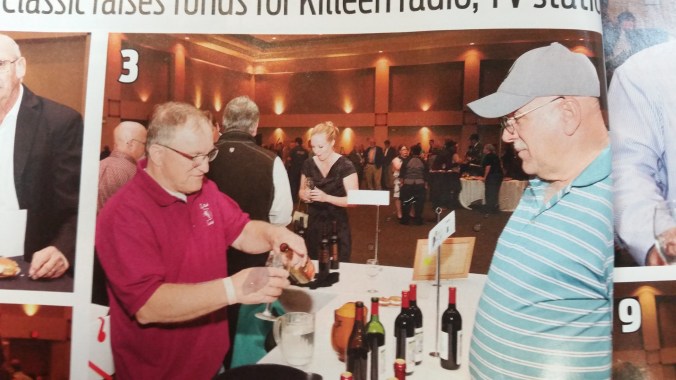
Here I am at the wine tasting fundraiser for the campus-hosted public radio and television stations. The event actually happened April 1 (my workiversary) but the photo was just published in the local society magazine. I am not named in the caption, by the way.

FullSizeRender

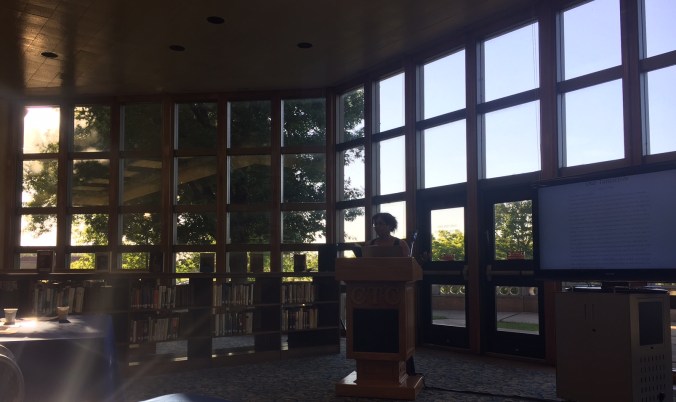
This is the launch of the campus literary journal, which took place on Wednesday evening in our library. Isn’t it gorgeous? We have the best view from a library I’ve ever seen in person.

IMG_0931

Here I am, dying, during the 5k around campus this morning. I love the Golden Arches in the background.

Girl, you got an ass like I never seen

Today marks the final issue of Bookslut, the end of fourteen years of books coverage and a brand of irreverent blogging that always assured me it was okay to be a little bit of a weirdo. The founder and life force, Jessa Crispin, is moving on in her writing career, having already released two books in the past year. The Dead Ladies Project is without a doubt the best travel book I have ever read, and while I haven’t gotten to The Creative Tarot, I did get a personal reading from Jessa and love how she approaches tarot cards as a conduit for storytelling. As much as I’ll miss my favorite blog, times are changing, and Bookslut’s Wake is Friday night at Melville House if you happen to be in Brooklyn.

In the spirit of reaching out for something new, I started Chantix today. I am fully prepared to hate everyone and everything, so I skipped the gym and traded gossip with the mean girls from work for a nature walk with my dog. My playlist these days is solid Prince, another life force who always assured me it was okay to be a little bit of a weirdo. Little Red Corvette plays a particularly humorous role in my personal history, seeing how I was six months old when it was released and grew up claiming a favorite song that contains nuances I could not possibly understand until much, much later. 

Even today, as I was staring at the built-in lyrics scroll on the Amazon music app (yes, Amazon, but we all know he had his music locked down exactly where he wanted it) I finally noticed that the gasped/growled line I always took as “Girl, I’m gonna dance like I never did” is actually “Girl, you got an ass like I never seen.” I was on the homestretch of a two-mile walk as I realized this, and I have not laughed so hard in months. It was Prince letting me know he still loves me, and that I should never, ever forget how raunchy he could be. It also gave me a little pride, knowing the Purple One’s shoutout to fat-bottomed girls had been there all along; I just had to love myself enough to find it.

Sometimes a presence can be so ubiquitous that it almost fades into the background, like Shakespeare’s phrases in the English language, or the book with a well-known cover used as home decor, or a song so universally beloved that it makes a millennial stop and say, “I didn’t know Prince sang this.” I’m the same way with the header image on Bookslut.com. It’s like I became numb to it, forgot to consider what someone looking over my shoulder would think or whether or not the website would be deemed Safe For Work. Until today, I hadn’t realized that I’ve spent the past fourteen years with a little squiggly drawing of the Bookslut’s ass lounging at the top of my browser. 

All credit, image and otherwise, to Bookslut.

Speaking of Book Clubs

img_1580

Yesterday I was talking with my boss/mentor about my discouragement regarding the book club incident, and she handed me this book: The Argonauts by Maggie Nelson. She said she’d found it in the New Yorker and wanted to know what I thought. We recently attended a Safe Space training that got us talking about gender fluidity within linguistics, and this book touches on those topics in the context of a relationship that, at first glance, reminds me of Patti Smith and Robert Mapplethorpe in Just Kids.

Funnily enough, later that night I saw a post about Emma Watson’s book club, Our Shared Shelf, selecting The Argonauts as their May book. I was hesitant to get caught up in Hermione’s book club when it started because I’m a bit fatigued with the Harry Potter franchise, and I admit that there was a moment, around the time of the Burberry ads and the theatrical release of The Perks of Being a Wallflower, when I was all, “Stop trying to make Emma Watson happen.” But she has turned into the best kind of feminist starlet, and her book club is better than my book club, so I just joined the group on Goodreads.

I read a bit of The Argonauts last night, but it is not the sort of book you read while falling asleep, and I read a little more closely over cereal this morning. My boyfriend immediately asked if it had to do with Jason and the Argonauts, but the title comes from Roland Barthes’ writing about love being like a structural object that is in a constant state of renewal, and the image he uses is the Argo.

Just as the Argo’s parts may be replaced over time but the boat is still called the Argo, whenever the lover utters the phrase “I love you,” its meaning must be renewed by each use, as “the very task of love and of language is to give to one and the same phrase inflections which will be forever new.” (Nelson, page 5)

Without getting to deep into linguistics, which I’ve never formally studied, my starting point for this book is that romantic mantra for grammar geeks: Love is a verb.